There is a particular moment many parents know by heart. The playground is full, a group of kids has invented some game with rules only they understand, and your child is standing a few feet away. Watching. Not indifferent, not uninterested. Watching the way you watch something you want. And the distance between where they are standing and where the game is happening is only a few feet of mulch, but you know it is also something else entirely: the gap between wanting to join and knowing how.
If social skills are the part of your child’s development that sits closest to your heart, there is a reason. Most therapy goals are measured in data. This one is measured in birthday party invitations, in a sibling saying “want to play?” and getting a yes, in the first friend who shows up just for them. Connection is not one goal among many. For most families, it is the goal underneath all the others.
This article explains how social skills are actually taught: why these skills are genuinely difficult for children on the spectrum (and why that has nothing to do with how much they want connection), the four-phase process ABA therapy uses to move a skill from a therapy room to a family birthday party, what progress realistically looks like at home including the part where it temporarily looks like the opposite, and why summer, the season you are in right now, is one of the best windows of the year for this work. By the end, the playground moment will look different to you: less like a wall, more like a staircase with steps that can be named and taught.
Why Social Skills Are Hard for Children on the Spectrum (and What That Actually Means)
Start with the misconception worth retiring permanently: that children on the spectrum struggle socially because they prefer to be alone. Some children do need more solitude than others, and that preference deserves respect. But clinical teams see the other reality every day: children who hover at the edges of games, who light up when a peer finally approaches them, who ask their parents at bedtime why the other kids did not want to play. The desire for connection is usually there. What is missing is not motivation. It is a set of skills that neurotypical children absorb invisibly and children on the spectrum often need to be taught explicitly.
Consider what a simple playground interaction actually demands, processed in real time:
- Reading nonverbal signals at speed. Facial expressions, tone shifts, body positioning. A neurotypical eight-year-old reads “this group is open to one more” versus “this group is closed” in about two seconds, without knowing how they did it.
- Tracking other minds. Understanding that other people have interests, thoughts, and intentions different from your own (researchers call this theory of mind). It is the skill behind knowing that a conversation needs two topics, not just your favorite one.
- Timing the back-and-forth. Knowing when a pause means “your turn” versus “I’m thinking,” when to start talking, when to stop. Conversation is rhythm as much as words.
- Moving from parallel to interactive play. Playing next to someone and playing with someone are developmentally different skills, and the bridge between them is exactly where many children on the spectrum need support.
- Decoding rules nobody ever states. You join a game by orbiting it first, not by announcing your arrival. You do not open a conversation with a stranger by sharing forty facts about your favorite subject, even when that subject is the most interesting thing in the world to you. Nobody teaches these rules to neurotypical children either. The difference is that they infer them automatically, and children on the spectrum often do not.
Here is the reframe that changes how families approach this. Reading is a skill almost no child acquires by simply being around books; we accept without judgment that it requires explicit, structured teaching. Social interaction works the same way for children on the spectrum. The skills are learnable. They simply need to be made visible, broken into steps, and taught on purpose, which is precisely what a well-designed program does.
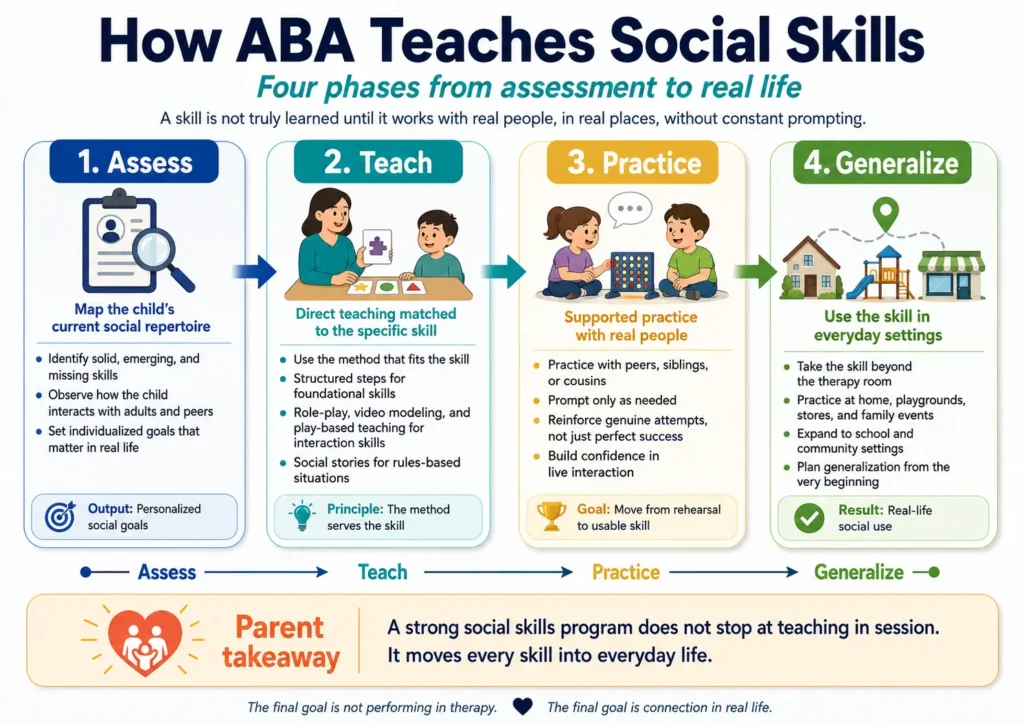
How ABA Teaches Social Skills: Four Phases from Assessment to Real Life
Social skills programs that work share a structure. Not a curriculum applied identically to every child, but a sequence that moves each skill from “new” to “used at a birthday party without anyone prompting it.” It has four phases.
Phase 1: Assessment, because every child’s social map is different
Before anything is taught, the BCBA maps your child’s current social repertoire: which skills are solid, which are emerging, and which have not yet appeared. One child may initiate constantly but struggle with turn-taking; another may have beautiful turn-taking with adults and freeze completely with peers. Those two children need different programs, and a provider who hands you a standard social skills checklist before observing your child has skipped the step that makes everything else work. The result of this phase is a set of individualized goals written into the treatment plan, chosen because they matter for this child’s actual life.
Phase 2: Direct teaching, matched to the skill
Different social skills respond to different teaching methods, and modern ABA has several to draw from. Foundational building blocks (responding to a name, requesting, taking a turn in a structured game) may be taught through discrete trial teaching, which breaks a skill into small, clear, repeatable steps. Conversational and play skills often come alive through role-playing with the RBT, video modeling (watching short clips of the exact social sequence, which many children on the spectrum learn from remarkably well), and approaches like pivotal response training that build skills inside play the child already enjoys. Rules-based situations (joining a game, greeting a new person) can be taught through social stories that make the invisible script visible. The method serves the skill, never the other way around.
Phase 3: Supported practice, where the skill meets real people
A skill rehearsed only with a therapist is a rehearsal, not yet an ability. In this phase the child practices with carefully structured peer opportunities: another child in the clinic, a sibling at home, a cousin at a family gathering, with the therapy team supporting, prompting only as needed, and reinforcing every genuine attempt. The standard here matters: attempts count, not just successes. A child who approaches a group and freezes has just done the hardest step in the entire sequence, and a good team treats it that way.
Phase 4: Generalization, the phase that decides everything
This is the phase that separates programs that produce clinic skills from programs that change lives, and it is the one most providers underinvest in. Generalization means deliberately taking the skill to the settings where it has to work: playgrounds, stores, home, family events, eventually classrooms. Methods like natural environment teaching exist for exactly this purpose. At Renaser, generalization is planned from the first day a goal is written, not bolted on at the end, because a greeting that only happens in a therapy room was never really the goal.
What Progress Actually Looks Like at Home
Here is the question parents actually carry: how will I know it is working? Clinic data answers part of it. But the moments that tell you the program is real happen in your kitchen, your backyard, your minivan. They are smaller than movies suggest and bigger than they look. What counts as progress depends on your child’s starting point, so treat the table below as illustrative, not as a schedule:
| Stage | Progress You Might Notice at Home |
| Early childhood (roughly 2 to 5) | Looking toward a sibling who calls their name; handing a toy to another child, even once; staying near a small group instead of leaving the room; a first point or reach to share attention (“look at that”) |
| Elementary years (roughly 6 to 11) | Staying inside a simple group game for five minutes; answering a peer’s question instead of only an adult’s; telling you one thing another child said today; tolerating losing a game without the afternoon unraveling |
| Older children and teens | Starting a conversation about a shared interest rather than only their own; noticing a friend seems upset and saying something; navigating a disagreement without shutting down; texting a peer first |
The part nobody warns you about: progress can look like regression first
This is the most counterintuitive thing in social skills work, and knowing it in advance saves families months of doubt. When a child starts attempting new social skills, things can temporarily look worse. A child who never approached peers starts approaching them and gets it wrong: stands too close, interrupts, melts down when the interaction does not go as rehearsed. From the outside this looks like a step backward. Clinically, it is the opposite. The child who avoided the social world entirely had zero friction because they had zero attempts. Friction means attempts. Attempts mean the skill is being used in the wild, where it is hardest. The clinical team expects this phase, supports it, and uses every rough interaction as data for the next adjustment. If you see it, you are not watching the program fail. You are watching it reach the difficult middle.
One number worth tracking at home: attempts, not outcomes. Count how often your child tries (approaches, greets, asks, joins) rather than how often it goes smoothly. Attempts are the leading indicator; smoothness follows with practice.
Why Summer Is One of the Best Windows for Social Skills Work
It might seem backward. School is where the other children are, so should the school year not be the social season? Not quite, and the distinction matters for how you use the months you are in right now.
School offers daily peer proximity, but it is a controlled, low-choice social environment: assigned seats, structured activities, adult-managed interactions. Summer’s social contexts are messier and, for exactly that reason, more like real life. Family gatherings, neighborhood kids, the pool, a cousin’s visit. These are the settings where generalization, the phase that decides everything, actually happens. Summer also removes a quiet pressure: there is no audience of twenty-two classmates when an attempt goes sideways at a family barbecue. Lower stakes, more varied settings, more family involvement. That combination is why our clinical team treats summer as prime season for social goals, and why community-based sessions feature heavily in Renaser’s summer programming.
Three ways to use the season well at home:
- Engineer one low-pressure peer opportunity per week. Short, predictable, ideally with a familiar child, ideally around an activity your child already enjoys. Forty-five good minutes beat a three-hour playdate that ends badly. Consistency builds the muscle; duration does not.
- Let special interests do the heavy lifting. A child who loves dinosaurs will attempt more social risk at a dinosaur exhibit with another kid than anywhere else on earth. Shared interest lowers the social processing load, which frees capacity for the skills being practiced.
- Treat rough moments as information, not verdicts. When an interaction goes badly, note what happened just before and tell the clinical team. That detail is programming gold. It is also worth distinguishing a hard social afternoon from a broader pattern; if you are seeing wider changes in skills this season, our guide to summer regression and what it actually means walks through how to tell the difference.
One commitment underneath all of this, stated plainly because it shapes every goal we write: the purpose of social skills teaching is never to make a child perform neurotypical friendship for an audience. It is to give them enough tools that the connection they already want becomes reachable, in their own style, at their own pace. That principle has a name and a practice behind it, and we wrote about both in our guide to neurodiversity-affirming ABA therapy.
Go back to the playground for a moment. The child standing a few feet from the game has not changed by the end of this article, but the few feet of mulch should look different now. Not a wall. A sequence of teachable steps: reading the group, timing the approach, saying the line, handling the answer. Every one of those steps can be assessed, taught, practiced, and carried into the real world. Thousands of children on the spectrum have walked that exact distance, one taught step at a time, and the first birthday party invitation that follows is the kind of data no spreadsheet captures.
If you would like to know where your child’s social skills stand today and what a program built around their specific profile would look like, the Renaser team offers social skills assessments at our West Palm Beach center for families across Palm Beach County. We will map what is solid, what is emerging, and what to teach first, and we will show you how the four phases would apply to your child specifically. Reach out to our clinical team here. The game on the playground is not going anywhere, and the steps toward it are more teachable than they look from the edge.