If you have spent any time researching therapy options for your child recently, you have seen the phrase. It appears on clinic websites, in provider directories, in parent groups: neurodiversity-affirming. Some providers feature it prominently. Others avoid it entirely. And if you have asked what it actually means for how your child will be treated in a session, you have probably received answers ranging from thoughtful to vague to suspiciously rehearsed.
Here is the honest situation. Neurodiversity-affirming care represents a real and meaningful evolution in how therapy is designed for children on the spectrum. It is also, increasingly, a marketing phrase that some organizations adopt without changing anything about their practice. Both things are true at the same time, which puts families in a difficult position: the term matters, but the term alone tells you almost nothing.
This article, reviewed by the team at Renaser ABA Therapy in West Palm Beach, takes the question seriously. We will explain what neurodiversity-affirming actually means and what it does not, walk through what genuinely changed in ABA therapy over the past decades (including the parts of its history that deserve honest acknowledgment), show what affirming practice looks like inside real sessions, and give you a set of questions that will reveal within one conversation whether any provider’s claim is substance or branding. By the end, you will be able to evaluate this for yourself, which is exactly where that power should sit.
What Neurodiversity-Affirming Actually Means (and What It Does Not)
The concept of neurodiversity emerged from the autistic self-advocacy community in the late 1990s, with sociologist Judy Singer widely credited with coining the term. The core idea is straightforward: neurological differences such as autism spectrum disorder, ADHD, and dyslexia are natural variations in how human brains work, not defects that need to be corrected. A child on the spectrum is not a neurotypical child with something wrong; they are a child whose brain processes the world differently, with genuine strengths and genuine challenges that both deserve to be taken seriously.
When that framework is applied to therapy, three commitments follow:
- The goal is never to make a child appear neurotypical. Therapy targets skills that improve the child’s own quality of life: communicating needs, building independence, participating in the activities and relationships that matter to them. It does not target traits simply because they look different.
- The child’s voice is part of the process. Preferences, comfort, and (for children who can express it) the child’s own goals shape the program. The clinical term for this is assent, and we will return to it in detail, because it is the single clearest marker of affirming practice.
- Difference and difficulty are distinguished. A child who flaps their hands when excited is doing something different. A child who cannot communicate that they are in pain is facing a difficulty. Affirming practice addresses the second without pathologizing the first.
What it does not mean
Neurodiversity-affirming is sometimes misread as a softer or less serious form of therapy. It is not. Affirming practice does not mean ignoring real challenges, avoiding structure, or declining to address behaviors that cause harm or close doors for the child. A child who runs toward traffic needs that addressed. A child who cannot yet request food, comfort, or help deserves effective teaching, urgently. The affirming question is never whether to help; it is what the help targets and how it is delivered. Researchers working with autistic communities have described affirming care in similar terms: support that addresses genuine needs while respecting the person’s neurology, autonomy, and dignity rather than treating difference itself as the problem.
What Changed in ABA Practice, and Why the History Matters
Families who research ABA encounter strong criticism of it online, and pretending that criticism comes from nowhere would be both dishonest and disrespectful to the people raising it. So here is the history, told plainly.
Early behavioral interventions in the 1960s and 1970s included practices that modern ethical standards reject without qualification: punishment-based procedures, aversive techniques, and programs built around the explicit goal of making children indistinguishable from their neurotypical peers. Adults on the spectrum who experienced those approaches have described lasting harm, and their accounts are a significant reason the field changed. Acknowledging this is not an attack on modern ABA; it is the context that explains why the modern ethical framework exists. Families weighing the strengths and criticisms of ABA deserve that context stated openly rather than buried.
Contemporary practice operates under the Behavior Analyst Certification Board’s ethics code, which requires board certified behavior analysts to prioritize reinforcement-based procedures, involve clients in decisions to the greatest extent possible, and select goals based on the client’s benefit. Modern approaches within ABA emphasize naturalistic, play-based teaching, and methods like natural environment teaching build skills inside the child’s real life rather than in drill formats. The field did not simply rebrand; its tools, its ethics, and its goals genuinely changed. The honest caveat is that change is not uniformly distributed. Practice quality varies between providers, which is precisely why families need evaluation tools rather than reassurances.
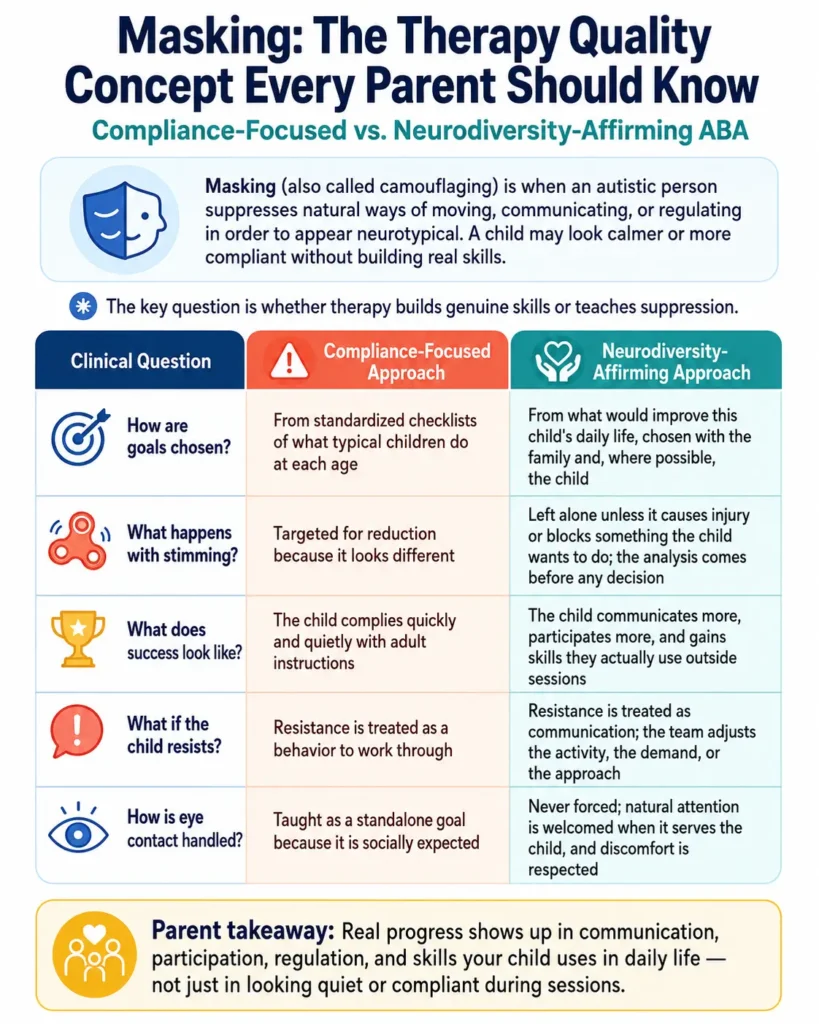
The concept every parent should know: masking
One idea from autistic self-advocacy has become central to evaluating therapy quality, and it deserves its own explanation. Masking (researchers also call it camouflaging) is when a person on the spectrum learns to suppress their natural ways of moving, communicating, and regulating in order to appear neurotypical. The autism research literature links chronic masking to exhaustion and diminished wellbeing in adults on the spectrum.
Here is why this matters for therapy: a program can produce a child who looks calmer and more compliant in sessions without building a single genuine skill, simply by teaching the child that their natural behavior is unwelcome. That is masking, manufactured by therapy. The visible result can fool well-intentioned adults, because suppression and progress can look identical from the outside for a while. The difference shows up later, at home, in fatigue, in regulation. Affirming practice is designed specifically to build real skills without teaching suppression, and the table below shows what that difference looks like in concrete terms.
| Clinical Question | Compliance-Focused Approach | Neurodiversity-Affirming Approach |
| How are goals chosen? | From standardized checklists of what typical children do at each age | From what would improve this child’s daily life, chosen with the family and, where possible, the child |
| What happens with stimming? | Targeted for reduction because it looks different | Left alone unless it causes injury or blocks something the child wants to do; the analysis comes before any decision |
| What does success look like? | The child complies quickly and quietly with adult instructions | The child communicates more, participates more, and gains skills they actually use outside sessions |
| What if the child resists? | Resistance is treated as a behavior to work through | Resistance is treated as communication; the team adjusts the activity, the demand, or the approach |
| How is eye contact handled? | Taught as a standalone goal because it is socially expected | Never forced; natural attention is welcomed when it serves the child, and discomfort is respected |
What Neurodiversity-Affirming Practice Looks Like
Claims are easy; specifics are the test. Here is how these principles operate inside actual sessions at West Palm Beach center, described concretely enough that you can compare them against any provider you visit.
- Assent is built into every session, at every age. Assent means the child agrees to participate, in whatever way they can express it. A verbal child can say no. A child who does not yet use words can turn away, push materials aside, or move toward the door. Our teams treat those signals as communication, not obstacles. When a child withdraws assent, the RBT adjusts: a different activity, a lower demand, a break. The session bends; the child’s signal is honored. This is not permissiveness. It is what teaches a child that their communication works, which is the foundation every other skill is built on.
- Stimming is analyzed before it is ever addressed. Behaviors like hand flapping, rocking, or vocal stims are not goals by default. If a repetitive behavior causes injury or genuinely blocks access to something the child wants, the team conducts a functional behavior assessment first to understand what the behavior does for the child, and any plan preserves that function through safer means. A behavior that simply looks unusual is not a treatment target. Full stop.
- Goals are written for the child’s life, not for appearances. Every goal in the treatment plan has to answer one question: how does this improve the child’s access to the things that matter to them? Requesting help, tolerating a haircut, joining a sibling’s game, communicating pain. Goals that only make the child easier for adults to manage do not pass that test.
- Families hear the reasoning, not just the plan. Parents are told why each goal exists, what the data shows, and what the alternatives were. If you ever want to know why your child’s program includes something, that explanation is yours by default, not by request.
One more commitment worth naming: language. Some people on the spectrum prefer identity-first language, others prefer person-first, and the conversation around which terms communities prefer and why is ongoing and personal. Our team follows each family’s lead on the language used about their child, because affirming practice extends to how we speak, not just how we teach.
How to Tell if Any Provider Is Actually Neurodiversity-Affirming
When you are evaluating any other ABA provider, these five questions will surface the truth within a single conversation. Listen for the shape of the answers, not just the words.
- 1. “How do you build assent into sessions for a child my child’s age?” A strong answer describes specific signals the team watches for and specific ways sessions adjust. A weak answer redefines the question: “we keep sessions fun” is about engagement, not assent.
- 2. “If my child stims, what happens?” The right answer starts with a question back to you: does it cause harm or block something the child needs? If the answer is an automatic plan to reduce it, you have learned what you needed to know.
- 3. “How do you choose goals, and can I see the reasoning?” Listen for individualization and family collaboration. A goal list that arrives fully formed before anyone has asked about your child’s daily life came from a template, not from your child.
- 4. “Do you ever use punishment-based procedures, and what does your escalation process look like?” A confident provider answers directly, explains their reinforcement-based approach, and describes exactly what happens when a behavior is dangerous. Vagueness here is disqualifying.
- 5. “Can I observe sessions?” The answer should be yes, with reasonable scheduling. A provider whose practice cannot be watched is asking for trust it has not earned.
The meta-signal: notice how the provider reacts to being asked. Teams that practice affirming care tend to welcome these questions, because they are the questions their own clinical standards are built on. Defensiveness is data.
The neurodiversity-affirming label will keep spreading, and the gap between providers who live it and providers who print it will keep widening. That makes informed families the real quality control in this field. You now have the history, the concepts, and the questions; what you do with them belongs to you and your child.
If you would like to see how these principles work in practice rather than in writing, the Renaser team welcomes exactly that. Visit our West Palm Beach center, ask us the five questions above (we would genuinely enjoy it), watch how our teams work, and decide for yourself whether the fit is right for your child and your family’s values. Reach out to our clinical team here to start that conversation. No scripts, no rehearsed answers, just the kind of transparency this article has been asking you to demand from everyone.