The parent-teacher conference ends with a sentence you have heard before: “He knows the material. He’s just not applying himself.” At home, the evidence seems to agree. The homework that took three hours last night is sitting on the kitchen counter this morning, finished and forgotten. The jacket is at school. The water bottle is somewhere. Your child can recite the household rules perfectly and still break one of them four minutes later, then look genuinely surprised that it happened.
From the outside, this pattern reads as carelessness, or as a discipline gap, or as the word teachers reach for when nothing else fits: unmotivated. Here is what three decades of ADHD research says instead: this pattern is none of those things. It is executive function and understanding it changes everything about how you respond to it.
Leading ADHD researchers describe the condition not as a problem of knowing what to do, but of doing what you know. That distinction sounds small. It is not. It is the difference between treating your child as someone who refuses to perform and supporting them as someone whose brain manages performance differently. This article, reviewed by the clinical team at Renaser ABA Therapy in West Palm Beach, explains what executive function actually is and how ADHD disrupts it, why the advice most families receive does not work and what does, how behavioral therapy builds these skills directly, and what you can start doing at home this week. By the end, several of your child’s most confusing patterns will make a different kind of sense.
What Executive Function Actually Is, and Why ADHD Disrupts It
Executive function is the set of mental skills that act as the brain’s management system. These skills let a person decide what to do, get started on it, hold the plan in mind while doing it, resist distractions along the way, notice when something is not working, and adjust. Every goal-directed action a human takes, from packing a backpack to writing an essay, runs through this system.
In children with ADHD, this system is developmentally delayed. Researchers estimate the lag at roughly thirty percent relative to peers, which in practical terms is often described as two to three years. A ten-year-old with ADHD may be working with the executive system of a seven-year-old, while facing the expectations, schoolwork, and social world built for ten-year-olds. The skills are not missing. They are arriving on a slower timeline, and they are far less reliable under demand. This is also why ADHD symptoms look so inconsistent: the same child who hyperfocuses on a passion project for three hours genuinely cannot sustain four minutes on a worksheet. Inconsistency is not evidence of choice. It is the signature of an executive system that runs on interest and immediacy rather than on importance.
The six domains, translated into your actual kitchen
| Executive Function Domain | What It Controls | What It Looks Like in Daily Life |
| Response inhibition | Pausing before acting or speaking | Calling out in class, interrupting conversations, grabbing before asking, blurting the thing they immediately regret |
| Working memory | Holding information in mind while using it | Three-step instruction, one step completed; walks upstairs for shoes, returns with a toy and no shoes |
| Cognitive flexibility | Shifting plans when circumstances change | A canceled playdate or a changed dinner plan triggers a reaction far bigger than the event itself |
| Planning and organization | Sequencing steps toward a goal and tracking materials | The backpack abyss; the project due tomorrow that was assigned three weeks ago; finished homework that never gets turned in |
| Time awareness | Sensing time passing and estimating how long things take | Twenty minutes feels like five; “I’ll do it in a minute” is sincere and also never happens; chronic surprise at deadlines |
| Self-monitoring | Noticing your own behavior and performance in real time | Drifts off task without realizing it; genuinely does not know why the teacher is upset; misjudges how the joke landed |
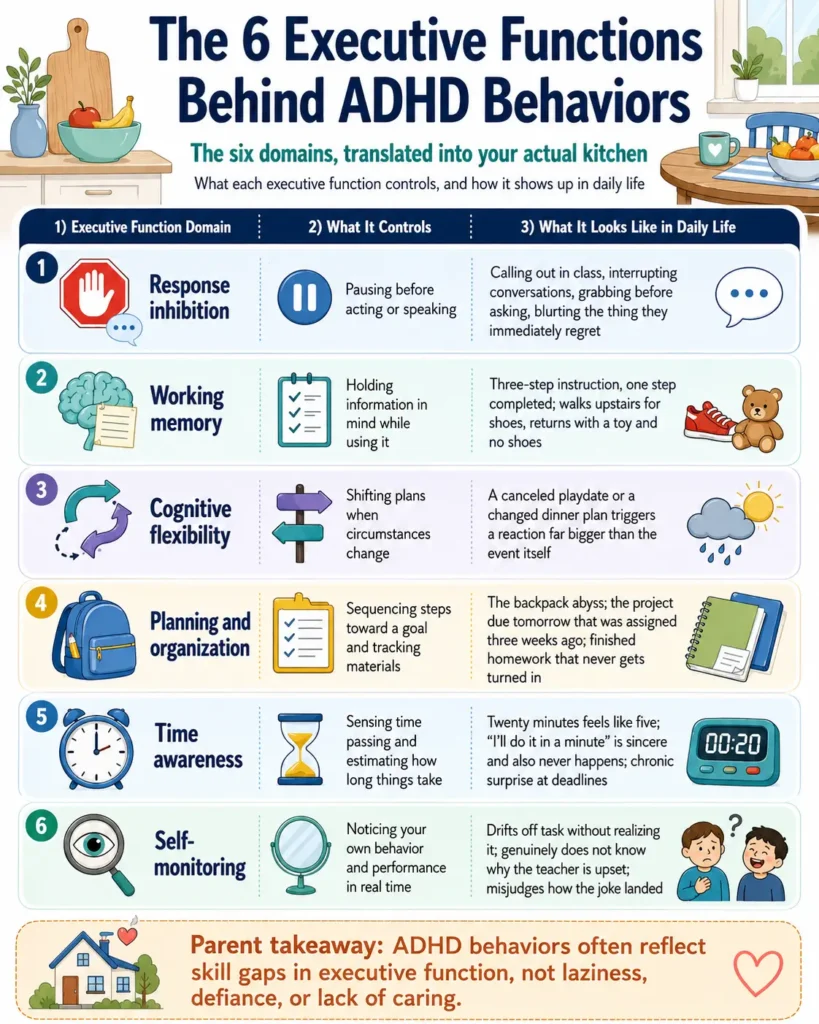
Read that table again and notice something: every row describes a behavior that is routinely interpreted as a character flaw. Lazy. Careless. Defiant. Dramatic. Each label assumes the child could perform and chose not to. The research points the other way. Whether your child’s profile leans inattentive, hyperactive-impulsive, or combined, the underlying story is the same: this is not defiance. This is executive function.
Why the Usual Advice Fails (and What That Teaches Us)
Most families arrive at behavioral therapy after years of strategies that should have worked and did not. It is worth understanding why they did not, because the failure pattern points directly at what does work.
- “Explain it again, more clearly.” This assumes the problem is comprehension. It almost never is. Your child can usually repeat the instruction back to you perfectly. The breakdown happens between knowing and doing, in the executive bridge that turns intention into action. More explanation adds nothing to a bridge that was never the problem.
- “Consequences will teach them.” Consequences that arrive hours or days after the behavior assume the child’s brain connects distant outcomes to present choices. That connection is precisely what immature executive function struggles to make. The child feels the consequence, certainly. What they do not reliably do is retrieve it in the next moment of decision, which is why the same consequence keeps being earned.
- “They’ll grow out of it on their own.” Executive skills do mature with age, but waiting passively has a cost: years of accumulating frustration, school struggles, and the corrosive self-story a child builds when they keep failing at things everyone insists are simple. Skills that are taught and scaffolded develop faster and with far less collateral damage than skills left to arrive whenever they arrive.
Notice the common thread. Every failed strategy targets motivation or knowledge. None of them targets the executive system itself. That is the gap behavioral therapy is built to fill.
How Behavioral Therapy Builds Executive Function Directly
Behavioral approaches, including the methods used in ABA-based therapy for ADHD, work on a principle that sounds almost too simple: if the internal management system is not yet reliable, build an external one, then transfer it inward gradually. Clinicians call this scaffolding. Done systematically, it is the difference between a child who depends on adult reminders forever and a child who develops their own working systems.
- Externalize what the brain cannot yet hold. Visual schedules, posted checklists, and timers move information out of working memory and into the environment, where it cannot be forgotten. The rationale matters: this is not a crutch. It is exactly how adults with strong executive skills operate (calendars, alarms, lists), introduced earlier and more deliberately.
- Shrink the task until starting is possible. Task initiation is the single highest-friction moment for the ADHD brain. Breaking “clean your room” into “put the books on the shelf” does not lower the standard. It lowers the executive load of step one, which is where most battles actually live.
- Reinforce in short, frequent cycles. The ADHD reward system responds to what is immediate far more than to what is important. Behavioral programs use point systems and frequent reinforcement not as bribery but as calibration: meeting the brain’s reward timeline where it currently is, then stretching it gradually.
- Teach self-monitoring explicitly. Children learn to check themselves at set intervals with a simple question: am I on task? At first the prompt is external (a timer, a card on the desk). Over time, the checking becomes a habit the child owns. This is executive skill being built from the outside in, visibly.
- Coach the parents as intensively as the child. The strongest evidence in childhood ADHD treatment supports parent training in behavior management. This is not because parents are doing anything wrong. It is because parents control the environment where executive demands happen hundreds of times a week, and small changes in how tasks are framed, sequenced, and reinforced at home compound faster than anything that happens in a session room.
Where does this sit alongside medication? They address different layers: medication can support the neurochemistry of attention while it is active, and behavioral therapy builds skills that remain when it is not. Families weighing that question can find the full evidence picture in our guide to behavior therapy versus medication for ADHD, and the decision itself always belongs with your child’s physician.
What This Looks Like at Renaser, and What You Can Start This Week
The clinical side
At Renaser, executive function work begins with assessment rather than assumptions. The BCBA maps which domains are driving your child’s specific struggles, because a working-memory profile and a response-inhibition profile need different programs even when the surface behavior looks identical. From there, the team builds an individualized behavior intervention plan with goals tied to the domains that matter most, coordinates with your child’s school so supports stay consistent across settings (including through a 504 plan or IEP where one exists), and coaches you on the home strategies that extend the work into daily life. Families dealing with school-specific challenges can go deeper in our guide to how behavioral therapy supports children with ADHD in the classroom.
Four strategies to start at home, each with its mechanism
- Write the first step only. Instead of “get ready for bed,” try “put your pajamas on, then come find me.” Why it works: it removes the sequencing load from task initiation, the highest-friction executive moment of all. One step is startable. A routine is not, yet.
- Make time visible. Use a visual timer (sand timer, countdown clock) for transitions and tasks. Why it works: time awareness is an executive skill your child cannot yet generate internally. A visible countdown externalizes it, turning “time to stop” from an ambush into a landing they watched approach.
- Put the checklist where the task happens. A three-picture morning list taped to the bathroom mirror beats any verbal reminder. Why it works: working memory fails at the point of performance, so that is exactly where the information needs to live. Not in your voice from the kitchen. On the mirror.
- Catch them succeeding within seconds. When your child starts a task without a prompt, name it immediately and specifically: “you started your homework on your own, that’s huge.” Why it works: immediate reinforcement is the signal the ADHD reward system actually registers. Praise delivered at dinner for something done at four o’clock arrives too late to teach anything.
These strategies work through repetition, not revelation. Two weeks of consistency will show you more than two days, and what you learn about which strategies move the needle for your child is exactly the information a clinical team can build on.
Here is the reframe this entire article has been building toward. A child with ADHD who gets through a school day, navigates a dozen transitions, and completes even half their tasks is not underperforming. They are running the same race as their peers while carrying an executive system that develops on a delay, which means they are working harder, not less hard, than the children around them who make it look easy. The label “not applying himself” has it exactly backward.
The right support does not ask your child to try harder. It builds the scaffolding that lets their effort actually land: external systems first, skills transferred inward over time, reinforcement that speaks the language their brain currently speaks. That is teachable, structured, measurable work. It is what behavioral therapy does.
If you would like to understand which executive domains are driving your child’s specific challenges, and what an individualized plan would look like, the Renaser team offers initial consultations for families across West Palm Beach, Wellington, and Boynton Beach. We will look at the real patterns (the backpack, the homework, the morning routine), tell you what they suggest clinically, and map out what support would fit your child and your family. Reach out to our clinical team here. The patterns that feel most confusing at your kitchen table are often the ones a trained eye can read most clearly.