If you’re reading this, your child has likely just received an autism spectrum disorder diagnosis, your insurance has authorized Applied Behavior Analysis (ABA) therapy, and now your provider is asking a question that feels deceptively simple: in-home or clinic-based?
It sounds like a logistical decision. It isn’t. The setting where ABA therapy happens shapes what your child works on, who participates, how your household runs, and how skills carry over into daily life. Choosing well depends less on which option is “better”, both can be highly effective, and more on which one fits your child, your family, and the goals that matter most over the next year or two.
This guide is written by the team at Renaser ABA Therapy in West Palm Beach. We’ll walk you through what each setting actually looks like day to day, which goals each one serves best, what’s specific about practicing ABA in Palm Beach County, and a simple framework to help you decide. Most families ultimately end up with some version of both, and we’ll explain why that’s often the right call.
What Each Setting Actually Looks Like Day to Day
Before comparing pros and cons, it helps to picture what a typical day looks like in each setting. The difference isn’t just where therapy happens, it’s how it feels for your child and what gets practiced.
In-home ABA therapy means a Registered Behavior Technician (RBT) comes to your home for scheduled sessions, typically two to four hours at a time, several days a week. The RBT works one-on-one with your child in the spaces where life actually happens, the kitchen during snack time, the bedroom during dressing routines, the living room during play. A Board Certified Behavior Analyst (BCBA) supervises the program, visits regularly, and adjusts the plan based on data the RBT collects each session.
You’ll see materials brought in: visual schedules, preferred toys used as reinforcers, data sheets, sometimes a tablet for tracking responses. Your child practices skills in the setting where they’ll need to use them. If the goal is independent toothbrushing, the practice happens in your bathroom, with your toothbrush, with the lighting and water pressure your child is used to.
Clinic-based ABA therapy happens at a dedicated center designed for ABA. At Renaser’s West Palm Beach location, that means structured therapy rooms, sensory-friendly spaces, areas for play-based learning, and rooms set up to mirror common environments, a small kitchen for self-help skills, a play area for peer interaction, structured workstations for early academic readiness. Your child has a consistent therapy team and may interact with other children during planned group activities.
The setting is controlled. Distractions are minimized. The team has access to specialized materials, structured equipment, and a workspace built for learning. Sessions typically run from a few hours up to a full school-day length, depending on the authorized hour count.
Both settings deliver evidence-based ABA. Both involve the same ratio of one RBT per child with BCBA oversight. The principles are identical. What changes is what gets practiced, how easily skills carry over, and how your family fits into the process.
Which Setting Works Better for Specific Goals
Most articles compare in-home and clinic-based ABA in terms of generic pros and cons. We’ve found a more useful frame is to look at the goals you’re hoping to address. Different goals respond better to different settings.
In-home ABA tends to be the stronger fit when the primary goals involve:
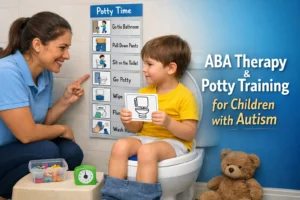
- Daily living skills, toilet training, dressing, eating routines, hygiene, bedtime transitions. These skills are tied to specific environments, and practicing them in the actual setting accelerates carryover.
- Parent and caregiver training, when family members are observing live and learning techniques in real situations, generalization happens faster and household routines get easier.
- Reducing behaviors that show up in specific home contexts, meltdowns during transitions between activities, difficulty during siblings’ bedtime routines, refusal at meals. Working in the trigger context allows the team to address what’s happening.
- Sibling and family system dynamics, when challenges involve interactions with brothers, sisters, or other family members, in-home practice gives the team direct access to those interactions.
Clinic-based ABA tends to be the stronger fit when the primary goals involve:
- Peer interaction and social skill development, planned interactions with other children under structured guidance are difficult to replicate in a home setting.
- School readiness and pre-academic skills, following multi-step instructions in a classroom-like environment, sitting at a workstation, transitioning between structured activities, raising a hand for attention.
- Behaviors that benefit from a low-distraction setting, children who become easily over-stimulated at home, or whose attention is pulled by household noise, screens, pets, or family activity, often progress faster in a controlled clinical space.
- Sensory regulation in a structured environment, clinical settings can be calibrated for sensory input in ways most homes can’t, especially for children who need predictable, controlled environments to engage.
- Structured task completion and discrete trial work, foundational learning programs that benefit from consistent setup, organized materials, and minimal interruption.
Many children have goals across both lists. That’s expected. It’s also why a hybrid approach, some hours at the clinic, some at home, is often the most effective plan, particularly once a child has built momentum and is ready to generalize skills across settings.
Practical Realities in Palm Beach County
Beyond clinical fit, the setting decision is also affected by where you live, how your insurance authorizes hours, and how Florida’s healthcare landscape works. These practical considerations matter, and most general ABA articles skip them entirely.
Travel times across the county add up. Renaser’s West Palm Beach location serves families from Wellington, Boynton Beach, Royal Palm Beach, Lake Worth, and surrounding communities. Depending on time of day, a one-way drive to the clinic can range from 15 minutes to over 45. For a child receiving 25–30 hours of ABA per week, the cumulative travel time can be significant. In-home eliminates that variable. For some families, clinic-based works because both parents work near the center; for others, it’s a full daily commitment that affects siblings and household logistics. There’s no right answer, but it’s worth doing the math before committing.
Therapist availability is currently strong at Renaser. We do not maintain a waitlist for new families. Once your insurance authorization is in place and the BCBA assessment is complete, your child can typically begin services without the months-long delays that some families encounter elsewhere. Both in-home and clinic-based services are available based on your child’s clinical needs and the family’s preferences.
Florida insurance and Medicaid plans authorize hours, not settings. Florida Medicaid (including Sunshine Health, Humana, Aetna Better Health, Simply Healthcare, and Children’s Medical Services) and most commercial plans (BCBS Florida, Aetna, Cigna, United Healthcare) authorize a number of weekly ABA hours based on the BCBA’s clinical assessment. Within that authorization, the family and clinical team decide how those hours are distributed between in-home, clinic, or a combination. The setting is a clinical decision, not an insurance one, though some plans do have specific procedure code distinctions.
Bilingual staff availability matters in Palm Beach County. For Spanish-speaking households, having an RBT who speaks the family’s language consistently, particularly during in-home sessions where communication with parents and siblings is constant, can meaningfully affect outcomes. Renaser’s clinical team includes Spanish-speaking RBTs and BCBAs, and we work to match families based on language and cultural fit.
Weather and unexpected interruptions are part of life in Florida. Hurricane season, heavy storms, and the occasional weather closure can affect any healthcare service in the region. ABA providers in Florida typically have contingency planning for weather-related disruptions. When you discuss services with any provider, including us, it’s worth asking specifically how they handle make-up sessions and continuity during weather events.
A Simple Framework to Decide (and Why Most Families End Up With Both)
Rather than choosing one option exclusively from the outset, most families benefit from working through four honest questions with their BCBA at the initial assessment:
1. Where do my child’s most pressing challenges actually happen? If the answer is “at home, during specific routines,” in-home is likely the stronger starting point. If it’s “in social settings, with other kids, or in school-like environments,” clinic-based is often more effective.
2. Is my child currently regulated enough to engage in a new environment? Some children need to build skills in the security of home before they can engage in a clinical setting. Others become more focused away from household distractions. Your BCBA can help assess this through observation during the initial evaluation.
3. What are the practical demands of having a therapist in our home for several hours a day? Consider siblings, work-from-home arrangements, household routines, available space, and family privacy. In-home is highly effective but does shape the household’s daily rhythm. There’s no shame in deciding that clinic-based fits your family better, it’s a real consideration, not a moral one.
4. What goals are we hoping to address in the next six months? If those goals are heavily weighted toward home-based skills (potty training, sibling interactions, mealtime), in-home leads. If they’re weighted toward social skills, school readiness, or peer interaction, clinic leads. If both, we’ll plan a split.
Most families benefit from a hybrid model. A common starting plan looks like: 10–15 hours per week at the clinic for structured learning and peer interaction, plus 10–15 hours at home for daily living skills and parent training. As goals are met, the distribution shifts. Some children eventually transition to fully clinic-based once home-based goals are mastered. Others move toward school-based or community-based work as their needs evolve. The plan isn’t fixed, it’s reviewed and adjusted with your BCBA on a regular schedule based on data.
What stays consistent across all settings is the foundation: an individualized plan built by a BCBA, sessions delivered by a qualified RBT under supervision, data-driven progress tracking, and regular family involvement in decisions. The setting is a delivery method. The therapy itself doesn’t change.
Choosing between in-home and clinic-based ABA isn’t about picking the “better” option, it’s about matching the setting to your child’s current goals and your family’s life. The right answer for a 4-year-old working on toilet training and sibling interactions may be different from the right answer for a 7-year-old preparing to enter mainstream classroom routines. And both answers may evolve over time.
If you’d like to talk through what would make sense for your child specifically, including whether a hybrid model would fit best, the team at Renaser ABA Therapy is available for an initial consultation. We’ll review your child’s needs, walk through both settings, and help you build a starting plan based on goals, not just logistics.
Schedule an assessment or initial conversation with our team to learn more about how we can support your family in West Palm Beach, Wellington, and Boynton Beach.