When a child hits, yells or runs away from the classroom, it is easy for parents and educators to feel that everything is out of control and to think only in terms of “bad behavior.” From a behavior analytic perspective, however, every action has a purpose for the child at that moment. Understanding that purpose is one of the most powerful tools families and teachers can use, especially when supporting children on the autism spectrum or children with other developmental needs.
In Applied Behavior Analysis, often called ABA, professionals talk about “functions of behavior.” The function is the reason why a behavior happens in a particular situation. A child might be trying to get someone’s attention, to escape something that feels overwhelming, to obtain a favorite item or to regulate their sensory experience. When adults understand this “why,” they can move away from reacting only with frustration and start building supports that truly match what the child is trying to communicate or achieve.
For many families of children on the autism spectrum, behavior can feel confusing and unpredictable. A routine that works smoothly one day may fall apart the next. Looking beyond how the behavior looks on the surface and focusing on its function helps parents and educators see patterns in what happens before and after each episode. These patterns reveal what the child might be gaining or avoiding through their behavior, and that insight opens the door to more compassionate and more effective responses.
At RenaSer ABA Therapy in West Palm Beach, the clinical team uses functions of behavior as a foundation for assessment and treatment planning. Rather than only trying to stop challenging behaviors, they take time to understand the context, listen to the family and observe the child. This information is used to design supports that make daily routines clearer, safer and more manageable for everyone involved.
If you are a parent, caregiver or educator who feels that the same difficult situations keep repeating, this guide is meant to support you. We will explore what functions of behavior are, describe the four main functions commonly discussed in ABA, explain how they are identified and show how they can be used to create practical intervention plans for children and the adults who care about them.
What Are the Functions of Behavior?
In behavioral science, the function of a behavior is the effect that behavior has on the environment or on the person. In simple terms, the behavior “works” because it helps the child achieve something, such as getting attention, avoiding a demand, gaining access to a favorite item or changing how their body feels. When a behavior is successful at meeting a need, the child is more likely to use it again in similar situations.
Research and clinical practice have shown that although challenging behaviors may look very different on the surface, they often share a limited number of common functions. Understanding these functions allows adults to organize what they are seeing instead of treating each episode as a completely new problem or as a reflection of “personality.” This perspective shifts the question from “What is wrong with this child?” to “What is this child trying to obtain or avoid through this behavior?”
It is important to distinguish form from function. Two children may show very different behaviors, such as leaving the classroom without permission or becoming completely silent and still, yet both may be trying to escape a task that feels too difficult. At the same time, a single behavior, such as shouting, can serve different functions in different situations. In one context it might bring attention, in another it might result in the removal of a demand.
For many children on the autism spectrum, behavior often acts as an extra language, especially when spoken communication is still developing or when emotions are so intense that it is hard to find words. Looking at behavior from a functional perspective does not mean accepting everything without limits, yet it does invite respect. Instead of focusing only on “How do I stop this?”, adults can begin to ask “What is my child telling me, and how can I teach a safer, more effective way to meet that same need?”
At RenaSer ABA Therapy, Board Certified Behavior Analysts combine caregiver interviews, direct observation and data collection to identify the most likely functions of behaviors that concern the family. This information guides the selection of treatment goals and the strategies that will be used in the clinic, at home and, when possible, in school settings.
The Four Functions of Behavior
Within ABA, professionals commonly describe four main functions of behavior: attention seeking, escape or avoidance, access to tangibles and sensory stimulation. These categories are not meant to capture everything about a child’s experience, yet they offer a clear framework to understand why many challenging behaviors keep occurring.
This model is a flexible tool rather than a rigid label. A single behavior can sometimes have more than one function at the same time, and other factors such as sleep, physical health, stress and life events also influence behavior. Even so, keeping these four functions in mind helps parents and educators move away from the idea that behavior is random and toward a more organized way of understanding what is happening.
RenaSer’s specialists use the four functions as part of a broader assessment process. They combine this framework with information about the child’s developmental level, communication skills, sensory profile and family priorities. The aim is always to see the child as a whole person, not just as a collection of behaviors or a single function.
Attention-Seeking
Attention seeking behaviors are actions that result in other people looking at, talking to or interacting with the child. This attention can be pleasant, such as praise or shared laughter, or it can be negative, such as scolding or stern looks. From a behavioral perspective, if a shout, a dramatic gesture or a joke in the middle of class brings adults over quickly, those behaviors have successfully obtained attention.
Children on the autism spectrum or children with communication challenges may rely more heavily on attention seeking behaviors when they do not yet have reliable ways to ask for help, comfort or connection through spoken language or alternative communication. A child may hit a sibling not because they truly want to cause harm, but because that action has become the fastest way to make an adult react. Understanding this does not excuse the behavior, yet it changes how adults respond and encourages teaching rather than only punishing.
Parents and educators can support children whose behaviors are maintained by attention by offering frequent positive attention for more appropriate behaviors. Noticing when a child raises a hand, waits quietly or uses a polite request, then responding with specific, warm praise, gradually shifts the balance. At the same time, adults can practice briefly ignoring minor negative behaviors so that yelling or interrupting no longer “works” as well as calm communication.
In RenaSer programs, therapists coach families and teachers to build small moments of connection throughout the day. They encourage caregivers to “catch the child doing something right” and respond with genuine appreciation, while teaching simple and respectful ways for the child to ask for attention, such as raising a hand, tapping an adult’s arm or using a short phrase. Over time, these alternative behaviors can replace shouting or disruptive actions.
Escape or Avoidance
Escape or avoidance behaviors allow a child to get away from something that feels too hard, unpleasant or overwhelming. A child may throw materials, complain of feeling sick, put their head down or walk away when a particular task or situation appears. If these behaviors consistently lead to a break, a change of activity or the removal of a demand, the pattern is reinforced and more likely to continue.
For many children on the autism spectrum, escape behaviors are closely linked to anxiety, sensory overload or tasks that are not well matched to their current skills. A noisy cafeteria, a worksheet filled with items, or a sudden change in the schedule can all trigger a strong urge to escape. Recognizing that the function is escape prompts adults to ask whether the environment and expectations are fair and what supports can be added to help the child stay engaged.
Helpful strategies for escape maintained behaviors often include breaking tasks into smaller steps, using visual schedules, offering limited choices and building in short, planned breaks that are earned through effort rather than through disruption. Teaching a child to ask for help, to request a break or to use a coping strategy gives them tools to meet the same need without needing to run away or shut down.
At RenaSer, behavior analysts pay close attention to which situations trigger escape or avoidance. They work with families and schools to adjust routines, maintain high but realistic expectations and create support plans that reduce panic and increase the child’s sense of success. This approach can significantly lower stress for the child and for the adults around them.
Access to Tangibles
When the function is access to tangibles, behavior appears because the child wants a specific item or activity. A child may grab a tablet from a sibling, cry loudly in the store aisle for a snack or refuse to get dressed unless a favorite toy is handed over. If these actions result in the child getting what they wanted, the behavior is reinforced and becomes more likely.
This function is very common in childhood and does not mean a child is selfish. Many children, particularly those on the autism spectrum, have strong interests or sensory preferences that make certain objects or activities especially motivating. The goal is not to remove all access, but to teach more appropriate ways to request what they want and to set clear, predictable limits about when and how those items are available.
Parents and educators can support children whose behavior is driven by access to tangibles by teaching communication skills such as using words, pictures or gestures to ask for things, by using simple “first–then” structures to make expectations clear and by creating token systems where children earn special items or activities through positive behavior. It is also important to avoid giving in to unsafe or aggressive behaviors, since providing an item after aggression sends the message that this is an effective strategy.
RenaSer ABA Therapy integrates children’s interests and favorite activities into teaching plans as planned reinforcers. Therapists work with families to use these motivators as allies for learning communication, flexibility and self control, while maintaining boundaries that keep everyone safe and reduce constant power struggles.
Sensory Stimulation
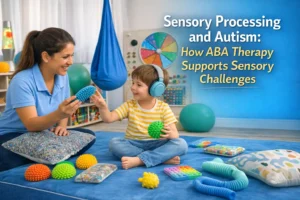
Sensory stimulation, also called automatic reinforcement, is present when the behavior itself produces an internal sensation that is calming, organizing or simply enjoyable. Rocking, hand flapping, spinning objects, humming, chewing on clothing or seeking deep pressure are common examples. These behaviors may occur even when no one else is nearby, because they are maintained by how they feel rather than by other people’s reactions.
For many children on the autism spectrum, sensory stimulation plays a major role in behavior. The world can feel too bright, too loud or too unpredictable, and repetitive movements or sounds can help the child cope. Not every sensory behavior is a problem. Some are harmless and can be accepted as part of the child’s way of managing sensory input, while others may need to be changed if they are unsafe or severely limit participation in daily activities.
Support strategies for sensory maintained behaviors often include offering safe sensory alternatives, planning regular sensory breaks and, when appropriate, consulting with occupational therapy providers. Rather than trying to stop all repetitive behaviors, adults can help children meet their sensory needs in ways that fit better with the environment, such as using fidgets, chewing on appropriate items or having access to quiet spaces when they feel overwhelmed.
RenaSer’s team collaborates with families to understand each child’s sensory profile and to decide together which behaviors truly need to change, which can be accepted and which can be gently redirected. This respectful approach prevents constant battles over behaviors that are helping the child cope and allows energy to be focused on areas where support is most needed.
| Function of Behavior | What the Child Is Trying to Achieve | Common Examples | How Adults Can Support |
| Attention-Seeking | Gain interaction, connection, or a reaction from others (positive or negative) | Shouting, interrupting, hitting a sibling, acting silly during class | Provide frequent positive attention for appropriate behaviors, teach respectful ways to ask for attention, and limit reactions to minor disruptive behaviors |
| Escape or Avoidance | Get away from tasks, situations, or environments that feel overwhelming or too difficult | Refusing work, leaving the area, putting head down, complaining of feeling sick | Adjust task difficulty, use visual supports, break tasks into steps, teach how to request breaks or help |
| Access to Tangibles | Obtain a preferred item or activity | Crying for a toy, grabbing a tablet, refusing to comply unless given a reward | Teach functional communication, use first–then language, reinforce patience, and avoid giving items following unsafe behaviors |
| Sensory Stimulation | Experience internal sensations that feel calming, organizing, or enjoyable | Hand flapping, rocking, humming, spinning objects, chewing clothing | Offer safe sensory alternatives, plan sensory breaks, accept harmless behaviors, and gently redirect unsafe ones |
Identifying Function of Behavior
Knowing that four main functions exist is helpful, yet the real impact comes from identifying which function is maintaining a specific behavior for a specific child. This process requires calm observation, data collection and collaboration between families, educators and professionals. Instead of guessing, adults look for patterns that show what tends to happen before and after the behavior.
A simple tool many families use is the “ABC” framework: antecedent, behavior and consequence. The antecedent is what happens right before the behavior, such as an instruction, a noise, a change in activity or a longer wait than usual. The behavior is what the child does, and the consequence is what happens immediately after, for example whether the child receives attention, escapes a task or gains an item. Over time, these observations reveal which function appears most often.
For children on the autism spectrum, it is important to look beyond a single episode and to consider sleep, health, eating patterns, recent changes and the number of demands placed on the child. A behavior that first appears to be attention seeking may actually be influenced by physical discomfort or intense anxiety. When behavior affects safety or significantly interferes with learning, a more formal assessment is usually recommended.
RenaSer ABA Therapy uses questionnaires, structured interviews and direct observations to build a detailed picture of what happens around challenging behaviors. The active participation of the family is essential, since caregivers know the routines, transitions and subtle cues that may not be visible in a brief clinic visit.
Conducting a Functional Behavior Assessment (FBA)
A Functional Behavior Assessment, or FBA, is a systematic process used to understand why a concerning behavior keeps occurring. An FBA gathers information from different sources, including family reports, teacher input and direct observation, with the goal of identifying the function of the behavior and the conditions under which it is most likely to appear.
During an FBA, the team defines the target behavior in clear, observable terms, collects data on when, where and with whom it occurs, and looks for patterns in antecedents and consequences. In some cases, carefully planned conditions are used to see how behavior changes when certain variables are adjusted, always with the child’s wellbeing as the highest priority. The goal is not to trap the child, but to understand what the behavior is achieving from their point of view.
In school settings, FBAs are often used as a foundation for behavior support plans and for decisions within Individualized Education Programs when behavior interferes with learning. Many official guidelines encourage schools to rely on FBAs to move away from purely punitive responses and toward positive, educational supports that teach new skills. Families have the right to ask questions, share information and, in many situations, request that an FBA be conducted when they see ongoing difficulties.
At RenaSer, the FBA is a central part of clinical work. Board Certified Behavior Analysts lead the process, explain each step to the family and use the results to create concrete, realistic and respectful Behavior Intervention Plans that fit the child’s needs and the family’s values.
If you are seeing patterns of behavior that keep repeating and you are not sure where to begin, requesting an FBA can be a powerful starting point. The RenaSer team can guide you through what the assessment involves, how information will be collected and how the results will be translated into practical support at home, at school and in other important environments.
Behavior Intervention Strategies
Once the function of a behavior is clear, the next step is to design intervention strategies that match that “why.” This is one of the core ideas in behavior analysis: interventions work best when they are tailored to the function of the behavior and not only to how it looks.
Approaches based on positive behavior support recommend combining proactive changes to the environment, direct teaching of new skills and intentional use of consequences, with a strong emphasis on reinforcement rather than punishment. For children on the autism spectrum, this means building plans that are structured yet flexible, that take into account how the child processes information and what helps them feel safe, and that include visual, sensory or communication support as needed.
At RenaSer, the results of each FBA are turned into Behavior Intervention Plans with clear guidance for families and, when possible, for teachers. These plans are reviewed regularly, adjusted to daily life changes and focused on goals that make a noticeable difference in home and school routines.
Function-Based Interventions
Function based interventions are strategies designed specifically to address the identified function of a behavior. If the function is to escape difficult tasks, the plan might include adjusting the difficulty level, providing clearer instructions, offering choices and teaching the child to request help or a short break. If the function is attention, the plan may focus on increasing positive attention for appropriate behaviors and reducing attention for behaviors that previously “worked.”
Research shows that function based interventions are more effective than generic strategies that ignore why the behavior is happening. When children learn that alternative behaviors reliably help them obtain attention, rest, items or sensory comfort, and that challenging behaviors no longer bring the same results, patterns begin to shift in a stable and lasting way.
For children on the autism spectrum, function based interventions also reduce the use of strategies that feel arbitrary or unfair. When expectations are clear, support is visible and adults explain, in a way the child can understand, what is expected and what will happen, the child’s sense of security grows and the need to test limits through extreme behaviors often decreases.
| Behavior Function | Intervention Focus | Examples of Strategies |
| Escape or Avoidance | Reduce overwhelm and increase success | Adjust task difficulty, offer choices, teach how to request breaks or help |
| Attention-Seeking | Shift attention to appropriate behaviors | Increase praise for positive actions, limit attention to disruptive behavior |
| Access to Tangibles | Teach appropriate requesting | Use first–then language, communication supports, clear limits |
| Sensory Stimulation | Support regulation safely | Offer sensory alternatives, plan sensory breaks, accept harmless behaviors |
At RenaSer, every part of a treatment plan is reviewed through the lens of behavior function and child wellbeing. Families are active partners in designing these interventions, so they understand why each strategy is being proposed and can carry it out consistently during calm moments and during stressful ones.
Replacement Behaviors
One of the most respectful ways to change behavior is to teach replacement behaviors that serve the same function in a safer and more socially appropriate way. If a child screams to escape a noisy room, the replacement might be using a card or phrase to request a quiet space. If a child grabs toys from peers to access them, the replacement might be asking for a turn, accepting a timer or using a simple phrase to negotiate.
For replacement behaviors to work, they need to be at least as easy and effective as the challenging behaviors they are meant to replace. Children need repeated practice with support, quick responses from adults when they use the new skill and real experiences of success. For many children on the autism spectrum, replacement behaviors involve gestures, photos, picture symbols or communication devices, not only spoken words.
Teaching replacement behaviors takes time, yet it creates deep and meaningful change. Children discover that they can express what they feel and need in ways that others understand and respect. This strengthens relationships with family members, peers and educators, and opens doors for greater participation in community activities.
| Challenging Behavior | Underlying Need | Replacement Behavior |
| Screaming to leave a noisy room | Escape from sensory overload | Requesting a quiet space with a card or phrase |
| Grabbing toys from peers | Access to a preferred item | Asking for a turn or using a timer |
| Walking away from work | Task avoidance | Asking for help or a short break |
In ABA programs, therapists and families work together to choose replacement behaviors that make sense in each setting, whether it is home, the classroom, the playground or the clinic. These skills are practiced repeatedly in calm situations so that children can rely on them more easily when emotions are intense.
Reinforcement Strategies
Reinforcement is a fundamental concept in ABA. A reinforcer is any consequence that makes a behavior more likely to occur again. Positive reinforcement means adding something pleasant after a behavior, such as praise, playtime, a special activity or a token that can later be exchanged for a reward. When used thoughtfully and consistently, reinforcement helps children understand which behaviors are valued and what they can expect when they use them.
Educational research suggests that strategies based on positive reinforcement are often more effective than approaches that rely mainly on punishment. Focusing on what the child is doing well and acknowledging those efforts reduces the need for extreme behaviors to gain adult attention. At the same time, it supports self esteem and strengthens the relationship between children and the adults who care for them.
The most effective reinforcement strategies are individualized. Some children respond best to kind words and shared time, while others are more motivated by special activities or symbolic rewards. Over time, many programs work toward more natural reinforcers so that success, calm routines and shared enjoyment become the main sources of motivation.
| Type of Reinforcement | What It Looks Like | Why It Matters |
| Social reinforcement | Praise, shared attention, encouragement | Builds connection and self-esteem |
| Activity-based reinforcement | Extra playtime, favorite activities | Increases motivation through enjoyment |
| Token or symbolic systems | Stickers, points, exchange systems | Helps structure learning and expectations |
| Natural reinforcement | Success, calm routines, shared joy | Supports long-term independence |
RenaSer ABA Therapy supports families in discovering which reinforcers are meaningful for their child and how to use them in a way that feels warm and aligned with their values. Caregivers are encouraged to pair rewards with words of recognition and, when appropriate, with gestures of affection, so that reinforcement becomes part of a caring relationship rather than a simple system of “rewards and consequences.”
If you feel unsure about how to use reinforcement without “spoiling” your child, the RenaSer team can help you explore options. Together, you can find a balance between kindness and clear boundaries so that reinforcement supports family life instead of creating new conflicts.
Conclusion
Understanding the functions of behavior can completely change how parents and educators view challenging moments. Instead of seeing only “bad behavior,” adults can begin to recognize signs that a child is trying to obtain attention, escape something overwhelming, access something important or regulate their sensory world. This shift from judgment to curiosity creates space for empathy and for strategies that truly work.
For children on the autism spectrum and for children with other developmental differences, this functional view is especially valuable. Many face daily challenges in communication, flexibility and sensory processing. When adults respond by teaching replacement behaviors, adjusting environments and using reinforcement thoughtfully, behavior can improve while trust and emotional safety grow at the same time.
Functional Behavior Assessments and Behavior Intervention Plans are practical tools for putting these ideas into action. They help teams move from improvisation to data based plans that focus not only on reacting, but on teaching new skills and building calmer, more predictable routines. Just as important, they remind families that they do not have to navigate these challenges alone.
RenaSer ABA Therapy is committed to using the science of behavior in a respectful, family centered way that fits each child’s reality. By focusing on behavior functions, teaching meaningful skills and working in close partnership with parents and schools, the team aims to reduce stress, create new opportunities and help children participate more confidently in their everyday experiences.
If you would like to understand more about what may be behind your child’s behavior and how an FBA and individualized intervention plan could support your family, the RenaSer team is ready to listen. A conversation can be the first step toward calmer mornings, afternoons with fewer conflicts and many more moments of connection at home and in the classroom.