It’s the third week of summer break. Your child was using two-word phrases consistently back in May, the speech notes from school said so, and you heard it yourself at dinner every night. This week, you’ve mostly heard single words. The morning routine that finally clicked in April, the one your whole family quietly celebrated? It’s taking twice as long again. And somewhere in the back of your mind, a question starts forming that you’re not sure you want to say out loud: are we losing the progress we worked so hard for?
Here’s the first thing to know: this question lands in the inbox of nearly every ABA clinical team in Florida every June. You’re seeing something real, and you’re right to pay attention to it. But here’s the second thing, and it’s the part most articles never tell you: not everything that looks like regression actually is regression. There are three distinct things that can happen to a child’s skills over summer, they look almost identical from the outside, and only one of them is true skill loss. The response to each one is different.
This article, reviewed by the clinical team at Renaser ABA Therapy in West Palm Beach, walks you through how to tell those three patterns apart, why summer specifically puts skills at risk for children on the spectrum, what ABA therapy actually does differently during summer months, and the home strategies that genuinely work, with the reasoning behind each one so you’re not just following a checklist. By the end, you’ll know what you’re looking at and exactly what to do about it.
What Summer Regression Actually Looks Like, and What It Isn’t
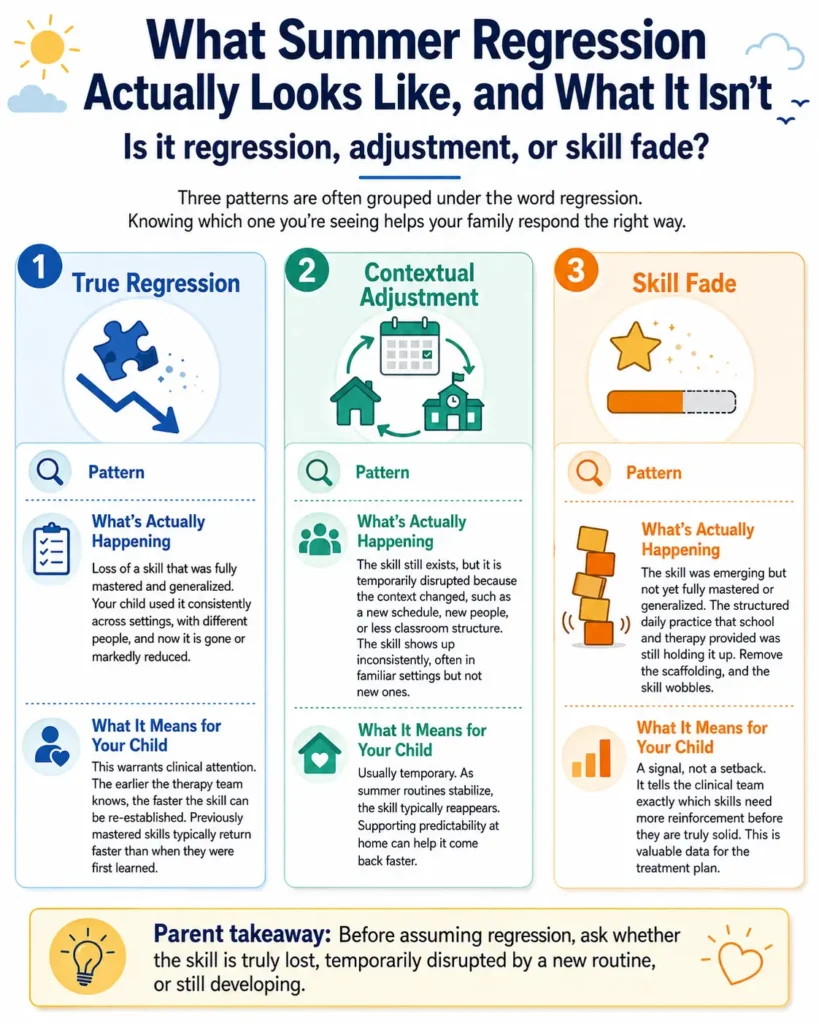
In clinical practice, three different patterns get grouped under the word “regression,” and separating them is the single most useful thing a family can do before deciding how to respond.
| Pattern | What’s Actually Happening | What It Means for Your Child |
| True regression | Loss of a skill that was fully mastered and generalized, your child used it consistently, across settings, with different people, and now it’s gone or markedly reduced. | This warrants clinical attention. The earlier the therapy team knows, the faster the skill can be re-established, previously mastered skills typically return faster than they were first learned. |
| Contextual adjustment | The skill still exists, but it’s temporarily disrupted because the context changed, new schedule, new people, no classroom structure. The skill shows up inconsistently, often in familiar settings but not new ones. | Usually temporary. As summer routines stabilize, the skill typically reappears. Supporting predictability at home accelerates this. |
| Skill fade | The skill was emerging but not yet fully mastered or generalized. The structured daily practice that school and therapy provided was still holding it up, remove the scaffolding, and the skill wobbles. | A signal, not a setback. It tells the clinical team exactly which skills need more reinforcement before they’re truly solid, valuable data for the treatment plan. |
Where to look: the skill areas where summer changes show up first
Summer changes don’t appear evenly across all skills. In clinical experience, they tend to surface first in four areas:
- Communication and language. Shorter phrases, less spontaneous speech, more reliance on gestures or leading you by the hand. Language is often the first area where reduced daily practice becomes visible, school days are saturated with communication demands that summer simply doesn’t replicate on its own.
- Self-care routines. Dressing, toothbrushing, mealtime independence. These skills are sequence-based, and sequences depend heavily on consistent daily repetition at the same time, in the same order.
- Social interaction. With school out, daily peer contact often drops to near zero. Turn-taking, greeting, and play skills can become hesitant without regular opportunities to use them.
- Emotional regulation. More frequent meltdowns, harder transitions, lower tolerance for changes in plans. For many children on the spectrum, the predictability of school was doing quiet regulatory work all year, and its absence puts more load on the child’s own regulation skills.
One reassurance worth stating plainly: noticing changes in these areas does not mean the year’s progress is gone. Skills that were genuinely mastered leave a foundation, and clinical teams see the same encouraging pattern repeatedly, re-teaching a previously mastered skill is consistently faster than teaching it the first time.
Why Summer Specifically Puts Skills at Risk
Understanding the mechanism matters, because every effective strategy, clinical or at home, targets it. The mechanism is predictability.
For many children on the spectrum, predictability isn’t a preference; it’s a regulating force. The school year provides an external structure so consistent that it’s easy to underestimate: the same wake-up time, the same bus, the same classroom, the same adults, the same sequence of activities, five days a week, for ten months. That structure does two jobs at once. It creates constant skill practice, hundreds of natural opportunities each week to communicate, transition, follow sequences, and interact with peers. And it provides regulatory support, when the environment is predictable, the child’s regulation system doesn’t have to work as hard, which frees capacity for using and building skills.
Summer removes both jobs simultaneously. The practice opportunities drop, and the regulatory demand rises, the child now has to manage more novelty and less structure with the same internal resources. That’s the squeeze that makes skills wobble. It’s not that summer is bad for children on the spectrum; it’s that summer asks more of them while giving them less support, unless families and clinical teams intentionally rebuild some of that scaffolding.
The Florida factors
Families in Palm Beach County face a few additional, very local realities that national articles never mention:
- The heat changes the day’s shape. By mid-June, outdoor time in South Florida compresses into early morning and evening windows. Park visits, playground time, and neighborhood walks, natural practice settings for social and motor skills, shrink just when they’re needed most.
- School-based services pause. Children who receive speech, occupational therapy, or school-based behavioral support through their IEP lose those service hours for the summer unless extended school year (ESY) services were approved, and ESY covers fewer children than most families assume.
- Family rhythms shift. Travel, visiting relatives, older siblings home all day, camps with rotating staff, each one is manageable alone, but stacked together they multiply the novelty a child has to process.
What ABA Therapy Does Differently During the Summer
A common misconception is that summer ABA is simply the school-year program running on a different calendar. Done well, it isn’t. At Renaser, the clinical approach shifts in specific, deliberate ways when summer begins, because the goal changes from building alongside school structure to compensating for its absence.
- A data check at the start of summer. The BCBA reviews which skills are fully mastered, which are emerging, and which are most vulnerable to fade, because data, not guesswork, determines where summer programming focuses. This is the clinical version of the three-pattern table above.
- Goals shift toward generalization. Summer is the natural season for natural environment teaching, practicing skills in the real settings where your child’s summer actually happens: the kitchen, the grocery store, the pool area, family gatherings. Skills practiced only in structured settings are precisely the ones most likely to fade; summer is the opportunity to make them portable.
- Parent involvement intensifies. During the school year, parents share the reinforcement work with teachers and therapists. In summer, the home becomes the primary practice environment, so the clinical team invests more in coaching parents on specific, daily strategies. This isn’t extra homework for families; it’s the highest-leverage move available, because consistent delivery, even a few hours a week, meaningfully reduces regression risk.
- Intensity adapts to the family’s summer. Some families maintain full hours; others reduce for travel or family time. There’s a clinical process for both. When hours decrease, the BCBA prioritizes ruthlessly: the most vulnerable skills get protected first, and the treatment plan is adjusted so that the hours that remain do the most important work. Sessions can run at the clinic or through in-home therapy, depending on what fits the season’s logistics.
What You Can Do at Home Right Now, With the Reasoning Behind Each Strategy
Generic summer tips fail families because they explain the what without the why. Here are four strategies the Renaser team coaches parents on, each with its mechanism, because when you understand why something works, you can adapt it to your actual life instead of abandoning it the first chaotic week.
- Anchor the day with three fixed points. Why it works: you don’t need to replicate a school schedule, you need to restore enough predictability for your child’s regulation system to relax. Consistent wake-up time, consistent mealtimes, consistent bedtime ritual. Those three anchors alone give the day a recognizable shape, and everything between them can stay flexible. Predictability is the single most protective factor available at home.
- Use a visual schedule, even a simple one. Why it works: during the school year, the environment itself told your child what was coming next. A visual schedule externalizes that same information at home. Three to five pictures on the fridge showing today’s sequence replaces the predictability the classroom used to provide. Update it together each morning, the act of previewing the day is itself regulating.
- Engineer small communication moments. Why it works: language fades when opportunities to use it fade. You can rebuild opportunities deliberately: place a preferred snack visible but out of reach, pause before handing over a desired item, offer choices instead of anticipating needs. Each engineered moment is a practice rep, and a dozen tiny reps a day outperform one structured drill.
- Protect one social opportunity per week. Why it works: social skills are the most practice-dependent skill area of all. One predictable, low-pressure peer contact per week, a cousin’s visit, a neighbor’s pool hour, a structured playdate, maintains the muscle. Keep it short, keep it consistent, and let the clinical team know how it goes; what happens there is useful data, not a performance review.
When to call the clinical team
Most summer changes fall into adjustment or skill fade and respond to the strategies above. But contact your child’s clinical team promptly if you notice any of the following:
- A fully mastered skill, one your child used consistently across settings, has disappeared rather than become inconsistent.
- Changes are accelerating week over week instead of stabilizing as summer routines settle.
- Regulation challenges are intensifying to the point of affecting safety, sleep, or eating.
- Your instinct simply says something more than seasonal adjustment is happening. Families know their children; that signal deserves a clinical conversation, not self-doubt.
Worth remembering: a check-in call in June is a small step. The same conversation in late August, after a summer of uncertainty, starts from further behind. Early information always serves your child better.
Summer doesn’t have to mean losing ground. The mechanics of summer regression are well understood, the warning patterns are distinguishable from ordinary adjustment, and the protective strategies, clinical and at-home, are concrete and achievable. Families who go into the season with a plan consistently come out of it with progress intact, and often with skills that are more portable than they were in May, because summer forced them out of the classroom and into real life.
If you’re noticing changes in your child’s skills this summer, or you’d simply like a professional read on whether what you’re seeing is adjustment, fade, or something that needs attention, the Renaser team offers summer check-in consultations for families across West Palm Beach, Wellington, and Boynton Beach. We’ll look at what you’re describing, tell you honestly which pattern it fits, and map out what would protect your child’s progress through August. Reach out to our clinical team here, a short conversation now keeps a whole season on track.