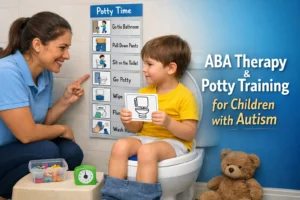
If your child’s first ABA therapy session is coming up at our West Palm Beach center, you probably have more questions than the standard articles online have answered. Most of what’s out there describes ABA in general terms, what the therapy is, why it works, what the research says. That’s helpful, but it’s not what you actually want to know the night before.
What you want to know is more practical. Will my child cooperate? How long does it last? Do I stay or leave? What if it goes badly? Will the therapist judge me, or my child, based on how the first session goes?
This guide is written by the team at Renaser ABA Therapy. It’s not a general overview of Applied Behavior Analysis. It’s a walk-through of what specifically happens during your child’s first therapy session at our center, what we’re paying attention to, and, just as importantly, what we are not measuring or evaluating you on.
Two Different “First Sessions”, Make Sure You Know Which One You’re Going To
Before we go further, there’s an important distinction that most articles online blur together. There are two different appointments families often think of as the “first session,” and they look very different from each other.
The first appointment is usually the BCBA assessment. This is conducted by a Board Certified Behavior Analyst (BCBA) and typically lasts 1.5 to 3 hours. The BCBA observes your child, applies standardized assessment tools (such as the VB-MAPP, ABLLS-R, or AFLS, depending on your child’s age and profile), interviews you about routines, challenges, and your priorities, and gathers the information needed to design a treatment plan. No therapy happens during this appointment. The BCBA isn’t teaching skills, they’re collecting clinical information. The output is a written assessment report and a proposed plan that gets submitted to your insurance for authorization.
The first therapy session comes later. Once your insurance authorizes the recommended hours, your child is matched with a Registered Behavior Technician (RBT), and the actual therapy program begins. This first therapy session typically runs 2 to 4 hours, depending on how many weekly hours have been authorized. This is when the relationship with the daily therapy team starts and when the first treatment goals begin being addressed.
These two appointments may be days, weeks, or sometimes longer apart, depending on how quickly your insurance processes the authorization. Knowing which one you’re heading to helps you set the right expectations. If your child has been authorized and you’ve been notified that therapy is starting, you’re going to a therapy session. If you’re still in the evaluation phase, you’re going to an assessment.
This article focuses primarily on the first therapy session, the one with the RBT, because that’s the one most parents have the most questions about.
What Actually Happens in Those First 2–3 Hours at Our Center
Here’s a realistic walk-through of what a first therapy session looks like at the Renaser West Palm Beach center, broken down by what’s happening at each stage. Your specific session may run shorter or longer based on the authorized hours, but the structure is generally the same.
The first 15–20 minutes, Arrival and pairing. When you arrive, you’ll be greeted at the front, and the BCBA or clinical lead will introduce you and your child to the assigned RBT. The first goal isn’t to start teaching anything, it’s something we call “pairing.” In ABA terms, pairing means the RBT becomes associated with positive things in your child’s experience: preferred toys, attention given on your child’s terms, fun activities, no demands. Your child might watch from across the room. They might warm up immediately. They might cling to you. All of these reactions are expected. The team’s job in this first stretch is to be patient and let your child set the pace.
Whether you stay or leave during this part depends on your child. For some children, having a parent in the room helps them feel grounded; for others, it makes it harder for them to engage with the new person. The BCBA will give you a recommendation based on what they observed during the assessment, but ultimately it’s a flexible decision and one we’ll make together.
The next 30–60 minutes, Low-demand observation and play. There are no structured drills or skill demands at this point. The RBT plays alongside your child, follows their lead, and offers preferred items based on what your child shows interest in. The BCBA may step in periodically to observe and confer with the RBT. From the outside, this often looks like “just playing.” It isn’t. The team is taking notes on baseline responses, attention patterns, communication attempts, sensory preferences, and how your child interacts with new materials. All of this informs how the rest of the session, and the coming weeks, are structured.
The next 30–60 minutes, Light skill probes. Once pairing is established and your child is comfortable, the RBT may introduce brief, low-pressure skill opportunities. These are small, responding to their name, requesting an item they want, simple imitation tasks, or initial communication trials. If your child engages, the RBT continues; if your child shows signs of being done, the team backs off. The first session is not about pushing through a curriculum. It’s about identifying what your child is ready to do and what they aren’t, today, in this setting, with this team.
The final 15–30 minutes, Wind down and parent debrief. Toward the end of the session, the team begins a calm transition. Your child gets help putting away materials, preferred activities are wrapped up, and the BCBA or RBT meets briefly with you to share initial observations. This conversation is short and high-level, what your child engaged with, what materials they responded to, how they handled transitions. It is not a behavior report card. It is not a list of concerns. It’s a starting point.
Throughout the session, the Renaser center has spaces designed for different needs, quieter areas for children who get overstimulated, sensory-friendly equipment, structured therapy rooms for skill work, and a parent waiting area where you can decompress while you wait. Our clinical team includes Spanish-speaking RBTs and BCBAs, which we work to match for families who prefer therapy delivered in Spanish.
What Probably Will Go “Wrong”, and Why None of It Is a Problem
Here’s the part most articles won’t tell you. We will, because it’s the most useful thing we can share before your child’s first session: a list of things that often happen on day one that families worry about, and why each one is actually expected.
- Your child may cry, hide, or refuse to engage with the RBT. Completely normal. Many children on the autism spectrum need time to warm up to new people in unfamiliar settings. The team is trained to be patient and not push. A first session that ends with your child watching the RBT from across the room, without a single skill drill, can still be a successful session.
- Your child may have a meltdown partway through. Also normal. New environments, new people, sensory shifts, and unfamiliar routines are a lot to process. The team knows how to support your child through difficult moments and how to wrap up a session safely if needed. A meltdown isn’t a failure of the session, it’s information about what your child needs help with, which is exactly what the team is there to learn.
- Your child may seem completely “fine” the whole time, and you may wonder if therapy is even working. Equally normal. Pairing is the goal of the first session, not skill mastery. If your child left the center willing to come back, that’s the outcome we’re looking for. Visible behavior change isn’t a session-one expectation.
- Your child may bond with the RBT immediately and not want to leave. Also common. Some children connect quickly with new people who follow their lead and provide positive interaction. Both reactions, cautious or eager, are valid starting points.
- You may have feelings during or after the session. Many parents do. Watching someone else work with your child can stir up a lot. There’s no “right” reaction. If you’d like to talk through what you observed, the BCBA is available to do so during the debrief or in a follow-up conversation.
- You may not see immediate behavioral changes after session 1, 5, or even 15. ABA progress is gradual and data-driven, not session-to-session dramatic. Skills are built incrementally, then generalized across settings, then maintained over time. Significant change typically becomes visible over weeks and months, not days.
The single thing we measure on day one is whether your child left the session willing to come back. That’s the only first-day metric that matters. Everything else builds from there.
Before You Come In, A Short, Honest Prep List
Most prep checklists online are full of advice that sounds reasonable but doesn’t actually move the needle. Here’s what genuinely helps.
Bring the right paperwork. Insurance card, the BCBA assessment report (if you have a copy), any previous evaluations from a psychologist, speech-language pathologist, occupational therapist, or developmental pediatrician, and your child’s IEP or 504 plan if they have one. The more context the team has, the better the first session goes.
Bring a comfort item, not a reward bag. A favorite stuffed animal, blanket, or small comfort object can help your child feel more settled in a new space. The team will use their own reinforcers for therapy work, calibrated to what they identified during the assessment, so you don’t need to bring snacks, candy, or a bag of toys.
Wear comfortable clothes, for both of you. You may end up sitting on the floor with your child, walking through the center, or moving between rooms. There’s no formal dress code. Comfortable, layered clothing tends to work best for kids who run warm or cold.
Don’t over-prepare your child. Telling your child something like “you’re going to learn good behaviors today” or “the therapist is going to fix some things” creates pressure that can make the first session harder. Saying something simple, “we’re going somewhere with toys and a new friend” or “we’re going to a place where you’ll get to play”, sets a more accurate and lower-pressure expectation. Visual schedules or social stories about “the new place” can also help children who do better with predictable previews.
Don’t plan a big event right after. After the session, your child may be tired, hungry, or in need of a regulated, low-key environment. The first session is more cognitively demanding than it looks from the outside. A quiet afternoon at home or a familiar low-stimulation activity tends to work better than birthday parties, errands, or unfamiliar outings.
The Renaser team also conducts a brief parent orientation before your child’s first session, where we walk through the program, answer questions, and review what to expect. You don’t need to come into the first day with all the answers, the orientation exists for exactly that reason.
Here’s the most important thing to keep in mind: the first ABA therapy session isn’t a performance review. It’s a first meeting. Your child is meeting their therapy team, the team is learning who your child is, and you’re getting a sense of what the coming weeks will look like.
If your child left the session willing to come back, even if they spent most of it observing from across the room, that’s a successful first day. If you left with fewer questions than you arrived with, that’s also success. Everything else gets built from there, session by session, week by week, with data, with care, and with you involved.
If you haven’t yet scheduled an initial assessment with our clinical team, or if you’d like to tour our West Palm Beach center and meet our BCBAs before your child’s first day, you’re welcome to schedule a meeting or assessment. We’ll walk you through the process, answer any questions you have, and help you feel prepared.