When families first hear about autism therapies, it can feel like learning a new language. You see terms like ABA, DTT, NET, PRT, and it is hard to know what any of them really look like in your child’s day to day life. Pivotal Response Training, usually shortened to PRT, is one of those approaches that many parents come across when they start looking for more natural, play-based ABA therapy.
At its core, PRT is a naturalistic form of Applied Behavior Analysis that focuses on a few key areas of development that researchers call “pivotal” skills. These include motivation, the ability to respond to more than one kind of cue, self-management, and the confidence to start interactions on their own. When these pivotal skills improve, children often make progress in many other areas at the same time, such as language, social interaction, and flexibility in daily routines.
For families in West Palm Beach, FL, this type of approach fits naturally within the work RenaSer ABA Therapy already does. Our team specializes in ABA services for children with autism and related developmental differences, using evidence based methods to build communication, social skills, and independence in ways that fit daily family life.
How PRT Fits Within ABA Therapy
Pivotal Response Training does not replace ABA. It lives inside ABA as one way of delivering teaching. The same science is there in the background. Therapists still look at what happens before a behavior, how the child responds, and what happens after. They still use reinforcement to strengthen useful skills and still track progress with data. The difference is that PRT shifts these tools into more natural, child led situations instead of relying only on structured drills at a table.
Many people are familiar with a very structured style of ABA called discrete trial training. In that model, the therapist gives a clear instruction, waits for a response, and then provides a reward or a correction. This structure can be powerful for teaching very specific skills that need a lot of repetition. At the same time, it sometimes feels separate from everyday life, which can make it harder for children to use those skills outside the therapy setting.
PRT grew in response to that limitation. Researchers like Robert and Lynn Koegel looked at how to keep the strengths of ABA while helping skills generalize more easily to home, school, and community settings. They moved teaching into play and daily routines, used the child’s own interests to drive motivation, and focused on pivotal abilities that influence many other behaviors.
Today, PRT is grouped within a larger family of approaches known as Naturalistic Developmental Behavioral Interventions. These interventions blend ABA principles with ideas from child development, emphasize shared control between child and adult, and rely heavily on positive, natural consequences like access to a favorite activity rather than separate reward charts. Reviews of these naturalistic interventions describe them as some of the most widely used and strongly supported approaches for young children on the autism spectrum.
ABA center like RenaSer, that means PRT style strategies can be combined with more structured ABA tools. A child might learn a new word or concept in a focused way first, then practice using it in play, at snack time, or during a family routine. The result is a treatment plan that respects the science but also feels more natural for both the child and the family.
Core Principles of Pivotal Response Training
The word “pivotal” is important. Instead of trying to teach every possible behavior one by one, PRT focuses on areas that tend to create a ripple effect. When these pivotal skills improve, many other behaviors often become easier to learn.
One of the central ideas is motivation. PRT is designed so that children genuinely want to take part in learning. The child often chooses the activity or toy, tasks include plenty of easy successes, and rewards are directly related to what the child is doing. If a child says “ball” or uses a picture for “ball,” they get to play with the ball, not something unrelated. Research shows that these motivational strategies, such as using child choice and rewarding attempts, can increase engagement and make interventions more efficient.
Another pivotal area is responding to multiple cues. Many autistic children tend to latch onto a single feature of a situation, such as the color of an object, and overlook others, like its size or the instructions given. In PRT, therapists gently encourage children to notice more than one aspect at a time. During a game with blocks, the therapist might talk about both color and shape. During language work, they might pair a spoken word with a gesture. Over time, this helps children respond more flexibly and reduces rigid, “one track” responses.
Self-management is another cornerstone. Instead of relying forever on adults to prompt and correct, children learn simple ways to track and organize their own behavior. This can look like checking off a small chart when they use a skill, noticing whether they followed a rule, or learning to pause and evaluate their own actions. Teaching self-management is linked with greater independence, because it shifts some of the control from adults to the child in a gradual, supportive way.
Finally, PRT puts a strong focus on initiation. Many autistic children respond when adults ask questions, but have a hard time starting interactions themselves. PRT actively encourages children to ask questions, make comments, and begin games or conversations, not just respond to them. Studies that look specifically at social initiation often find that PRT can increase spontaneous communication and engagement, which are key building blocks for relationships and participation in group settings.
Together, these four pivotal areas create a foundation. When a child is more motivated, can notice more than one cue, has tools to manage their own behavior, and feels confident starting interactions, many other skills tend to grow more easily on top of that base.
How PRT Works: Play Based, Naturalistic Teaching for Children with Autism
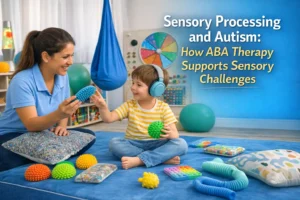
From the outside, a PRT session looks a lot like good quality playtime. A therapist might be on the floor with your child, surrounded by cars, puzzles, books, or sensory toys. There might be laughing, movement, and moments where the child clearly leads the activity. Underneath that relaxed appearance, there is a carefully planned structure.
Therapists start by getting to know what truly matters to your child. They pay attention to favorite toys, games, characters, songs, and daily activities. These interests are not treated as distractions. In PRT, they are the engine that pulls learning forward. During a session, the therapist follows the child’s lead toward a chosen activity, then looks for opportunities to build in short teaching moments.
Imagine a child who loves bubbles. The therapist might hold the bubble wand, wait for the child to look, reach, or make a sound, then pause. That pause becomes a space for teaching. The therapist models a simple phrase like “more bubbles” or helps the child use a picture or device to request more. The moment the child makes an attempt, the bubbles continue. Learning happens inside the fun, not separate from it.
The same pattern can appear in many situations. With a train set, the child might need to say “train,” “go,” or “my turn” to keep the game moving. With a snack, they might practice “cracker,” “drink,” or “all done.” While reading, they might be encouraged to point, label, or ask questions about the pictures. Every time they try, the reward is built into the activity itself.
PRT is not limited to one setting. It can be used in center, home, school, and community spaces. Because it fits into ordinary routines, it is especially well suited to early intervention. Reviews of naturalistic interventions, including PRT, describe positive effects on language, play, and social communication when these methods are used intensively with young children.
Parents are typically involved as partners. Many PRT studies include a strong parent training component, where caregivers learn how to recognize opportunities, give clear but natural instructions, and respond in ways that keep motivation high. Research on PRT parent training shows increases in children’s spontaneous language and social initiations, along with parents feeling more confident in how they support their child.
At RenaSer, this kind of collaboration fits well with their family centered philosophy. A child may practice skills with a therapist, then repeat those same patterns with parents and peers in daily routines, which is exactly where families want to see change.
Benefits of Pivotal Response Training for Children and Families
One of the clearest benefits of PRT for children is that learning feels directly connected to their own interests. They are not only answering questions on flashcards. They are using language to get a toy, to ask for help, to keep a game going, or to share something they noticed. This makes communication feel useful and rewarding, which encourages children to use it more often outside formal sessions.
Research supports this experience. Clinical trials comparing PRT with more structured ABA approaches have found that PRT can lead to equal or greater gains in certain areas, particularly in functional language and social communication. In one randomized trial in school settings, children receiving PRT showed stronger improvements in communication compared with those in other ABA therapy programs.
When researchers look across many PRT studies together, they often see consistent benefits in language and communication. A recent review and meta-analysis of randomized controlled trials reported significant effects of PRT on multiple communication outcomes, although the exact size of the effect varies depending on the child and the design of the study.
For families, the benefits are not only in the data. Because PRT uses play and daily routines, it can feel more like a way of living with your child than a separate block of “therapy time.” Parents often describe feeling more empowered because they know how to turn small moments into chances to practice communication or social skills. Qualitative research with parents who completed PRT group training programs describes increases in confidence, a clearer understanding of how to support their child, and a sense that everyday interactions became more meaningful and connected.
There is also a practical benefit in terms of generalization. Because PRT is rooted in settings, skills often show up more quickly in those same settings. A child who learns to ask for help during play is more likely to use that skill at home or school because it has already been practiced there. That can make daily life smoother for the whole family, not only during sessions.
Is Pivotal Response Training Right for Your Child?
No single approach is perfect for every child, and that includes PRT. It is helpful to think less in terms of “yes or no” and more in terms of “how much” and “where does this fit.” Since PRT is a way of delivering ABA, the real question is how strongly your child’s program should lean toward naturalistic, play based teaching compared with more structured formats.
PRT often works very well for young children who are curious, responsive to play, and motivated by social interaction or favorite activities. It is also a good match for families who want to be actively involved and are open to weaving strategies into everyday routines. If your main concerns are communication, social engagement, and flexibility in daily life, PRT offers a direct way to work on those goals.
If your child has more complex needs, such as very limited communication, high support needs, or intense behavior challenges, PRT can still be useful, but it may need to be combined with other ABA strategies. Some children benefit from more structured teaching at first to build foundation skills, then gradual movement into PRT style sessions as they become more comfortable with learning and interaction. That kind of blended approach appears frequently in the research, and many studies of naturalistic interventions include elements of both structured and play based techniques.
The best way to decide is through a careful assessment. At RenaSer, we usually start with getting to know your child’s strengths and needs, reviewing developmental history, and talking with you about your priorities as a family. A Board Certified Behavior Analyst can then recommend a mix of methods that may include PRT, more traditional ABA approaches, or other supports such as speech and occupational therapy when appropriate.
If you are reading about PRT and feeling a sense of relief because a play based, child centered approach sounds more like what you want, that is worth bringing to the conversation with your child’s treatment team. Your preferences matter, and PRT is flexible enough to be adapted to many different profiles and family cultures.
Conclusion
Pivotal Response Training shows how ABA can be both scientific and human. It keeps the careful planning, data collection, and analysis that make ABA effective, and places them inside daily moments that matter to your child. By focusing on motivation, responding to multiple cues, self-management, and initiation, PRT aims to unlock wider growth in communication, social interaction, and everyday learning.
For children, that can look like more words used for their purposes, more eye contact during play, more questions asked at home, and more confidence in new situations. For families, it can feel like fewer battles and more shared moments where you see your child connecting, not just complying.
If you live in or near West Palm Beach, FL, and are wondering whether PRT style strategies might help your child, RenaSer ABA Therapy can walk through the options with you. Our team specializes in ABA for children with autism and can design a plan that blends structured teaching with naturalistic, play based approaches in a way that fits your child and your family.
You do not have to choose between warmth and effectiveness. With approaches like Pivotal Response Training, it is possible to have both: solid science and joyful learning, standing side by side in your child’s everyday life.