Starting school is a big step for any family, but for families raising a child on the autism spectrum, that transition often comes with extra questions. Parents may wonder whether their child is ready, which skills matter most, what kind of classroom support may be needed, and how to make the first weeks of school feel less overwhelming. Those questions are valid, and they matter. The good news is that school readiness is not about expecting a child to walk into school already doing everything independently. It is about helping them build the skills that will make the school environment more manageable, more predictable, and more successful over time.
This is one reason ABA therapy can be so helpful before school starts. Instead of treating school readiness like one huge goal, ABA breaks it down into practical, teachable skills. A child may need support with following group directions, communicating needs, tolerating peers nearby, handling transitions, or managing simple self-care tasks. When those skills are taught clearly and practiced consistently, school can begin to feel much more accessible.
For families who want a practical, step-by-step way to prepare for school, RenaSer ABA Therapy supports school-readiness goals through individualized ABA services that connect directly to everyday routines, family priorities, and meaningful progress at home.
What Does School Readiness Mean for a Child with Autism?
School readiness is often misunderstood as an academic question. Many parents immediately think about letters, numbers, colors, shapes, or whether their child can sit with a worksheet. Those skills can matter, but for a child on the autism spectrum, readiness for school usually involves much more than academics alone.
In practice, school readiness often includes the ability to participate in the structure of a school day. That may mean sitting briefly for a group activity, responding when a teacher gives a direction to the whole class, transitioning from one activity to another, tolerating peers nearby, asking for help, following a visual routine, using the bathroom with support, washing hands, opening lunch items, or managing a backpack. These are the kinds of skills that shape how manageable school feels from day one.
That is an important shift for families because it takes pressure off the idea that readiness depends on being ahead academically. A child may not be reading yet and still be very ready to begin school. Another child may know many academic concepts and still need more support with transitions, communication, or classroom participation. School readiness is not about comparing children. It is about identifying the specific skills that will help that child access the school day with more confidence.
A useful way to think about readiness is this:
| School readiness area | What it may look like in daily school life |
| Group participation | Sitting for circle time, lining up, joining a class activity |
| Communication | Asking for help, requesting a break, answering simple questions |
| Social tolerance | Playing near peers, waiting for a turn, sharing space |
| Independence | Toileting, hand washing, opening lunch items, carrying a backpack |
| Coping with change | Moving between activities, handling schedule changes, staying calm when routines shift |
When parents view readiness through this wider lens, preparation usually becomes much clearer and much more useful.
Key School Readiness Skills ABA Therapy Can Build
ABA therapy can support school readiness by focusing on the specific behaviors that make classroom life easier to navigate. Instead of using broad goals like be ready for school, a strong ABA approach looks at the smaller skills underneath that idea and teaches them step by step.
Following Group Instructions and Classroom Routines
One major part of school readiness is learning how to respond when directions are given to a group instead of to the child individually. In school, children are often expected to line up, sit down, clean up, move to the next activity, or join circle time when the whole class is given a cue.
For many children on the autism spectrum, this is difficult because it requires noticing the instruction, understanding that it applies to them, and shifting behavior quickly enough to respond. A child may follow one-to-one directions very well and still struggle when the same direction is given to the whole room.
ABA can help by teaching these routines in smaller pieces. A child might first learn to respond to sit down or come here in a calm one-to-one setting, then practice with siblings or peers, and later build up to more classroom-like situations. That kind of progression often makes the skill feel much more manageable.
School-readiness goals in this area often include:
- responding to group directions
- lining up with support
- sitting for short group activities
- cleaning up when a class activity ends
- moving to the next task when cued
- tolerating circle time for increasing amounts of time
These are often the skills that shape how successful the first weeks of school feel, because they affect the child again and again throughout the day.
Communication and Requesting Help
Communication is another core readiness skill. A child does not need to speak in full sentences to be successful at school, but they do benefit from being able to express basic needs in some reliable way. That may be through spoken language, signs, picture exchange, a communication device, gestures, or another supported system.
In a school setting, communication often includes:
- asking for help
- requesting a break
- telling an adult they need the bathroom
- answering simple questions
- responding to their name
- indicating that something is wrong
- asking for more time or support
These skills matter because school moves quickly. If a child has no clear way to communicate discomfort, confusion, or a need for help, small problems can become much bigger. A child who can say, sign, or show help, break, or toilet often has a much smoother day than a child who has the same academic ability but no consistent way to express those needs.
ABA therapy can support this by teaching functional communication in naturally useful contexts. A child may practice asking for help with opening a lunch container, asking for a break before becoming overwhelmed, or answering simple teacher questions. These are not minor details. They are part of what helps school feel more accessible.
Social Skills: Sharing, Turn-Taking, and Parallel Play
School readiness also includes early social skills that influence classroom participation. A child does not need advanced friendship skills before starting school, but being able to tolerate peers nearby, share space, wait for a turn, or engage in simple parallel play can make a big difference in how manageable the classroom feels.
Pre-academic social skills often include:
- playing near another child without distress
- taking turns with adult support
- waiting briefly while another child has a turn
- sharing materials with prompts
- joining a short group activity
- responding to simple peer interaction
These are often the skills that make classroom life feel less stressful. A child who can tolerate sitting next to peers, wait for a turn during a group activity, or share access to materials may be much more comfortable in a classroom than a child who has stronger academic ability but cannot yet manage the social environment around them.
ABA can help by teaching these social behaviors in small, supported steps. That might include turn-taking during games, short peer play sessions, waiting with reinforcement, or practicing how to share materials with adult guidance. These early social goals are often some of the most important foundations for later classroom success.
Self-Care and Independence Skills
Independence skills are some of the most useful school-readiness targets because they affect the child’s day repeatedly. A child who can manage simple self-care tasks with less help often feels more capable and needs less adult prompting throughout the school day.
Common independence goals may include:
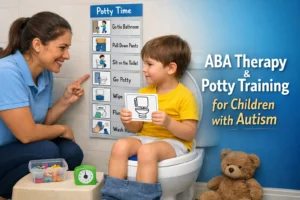
- toileting or toilet-related communication
- hand washing
- putting on or taking off simple clothing items
- opening lunch containers
- using napkins or utensils
- carrying and managing a backpack
- putting items away in the same place each day
These are practical skills, but they matter a great deal. A child who can wash their hands with fewer prompts, open a lunch item independently, or communicate that they need the bathroom may have a much smoother day and need less crisis-level support from adults.
ABA is especially helpful here because it can break these routines into smaller teachable steps, practice them repeatedly, and reinforce progress clearly.
Coping With Transitions and Unexpected Changes
School rarely unfolds exactly the same way every day. A teacher may be absent. A preferred activity may end earlier than expected. The class may move to a different room. Another child may make noise or stand too close. A schedule may change. For many children on the autism spectrum, this is one of the hardest parts of school.
This is why school readiness often includes learning how to:
- move between activities with support
- tolerate simple schedule changes
- follow a visual schedule
- ask for a break when needed
- recover after a frustrating moment
- handle sensory overload with support
- return to a task after something unexpected happens
These skills can have a huge impact on whether the child stays engaged across the school day instead of only during preferred moments. ABA can help by teaching transitions step by step, using visuals, building coping responses, and reinforcing flexibility in manageable ways.
Understanding Your Child’s School Placement Options
School placement decisions can feel confusing, especially for families entering the school system for the first time. It helps to remember that there is no single best setting for every child. The right placement depends on the child’s specific needs, communication profile, support requirements, learning style, and how much structure they need in order to access the school day successfully.
Families may hear about several possible placement models.
General Education with Supports
Some children on the autism spectrum do well in a general education classroom when support is built in. These supports may include speech therapy, occupational therapy, paraprofessional, visual support, sensory accommodations, behavior plans, or consultation from specialists.
This option may be a strong fit when the child can participate meaningfully in the general classroom with those added supports in place.
Inclusion Classrooms and Co-Teaching Models
Inclusion classrooms and co-teaching models usually combine general education and special education support within the same setting. This can give the child access to peers and classroom routines while also providing more structured support during the day.
For some children, this creates a helpful balance between access and support, especially when the classroom team is experienced and the support is consistent.
Self-Contained Special Education Classrooms
A self-contained classroom may be appropriate for a child who needs a more structured environment, a lower student-to-staff ratio, more direct adult support, or a setting that is better matched to their communication, sensory, or behavioral needs.
This option is not automatically better or worse than inclusion. It is simply one point on the continuum of support. What matters is whether the setting matches the child’s actual needs.
ABA-Based School Programs
Some children attend school programs that are more explicitly ABA-based or that integrate ABA principles more heavily into the school day. These programs may offer very structured teaching, data-driven goals, reinforcement systems, and consistent behavior support.
For some children, this type of setting can be a strong fit, especially if they benefit from very clear expectations, predictable routines, and highly systematic teaching.
A simple comparison may help:
| School placement | What it may offer | When it may help |
| General education with supports | Access to grade-level peers and curriculum | When the child can participate meaningfully with supports |
| Inclusion or co-teaching | Support from both general and special education staff | When the child benefits from both access and classroom support |
| Self-contained classroom | More structure and intensive support | When the child needs a smaller, more supported environment |
| ABA-based program | Highly structured, data-driven teaching | When the child benefits from very systematic instruction |
The most useful question is not which placement sounds best in theory. It is which setting is most closely aligned with the child’s actual needs and what will help them learn successfully.
Navigating IEPs and 504 Plans Before School Starts
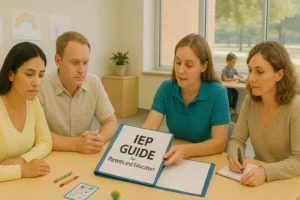
Before school begins, many families need to understand whether their child will be supported through an IEP or a 504 Plan. These two supports are related, but they are not the same.
In general terms:
| Support plan | Main purpose |
| IEP | Provides special education services, individualized goals, and related supports |
| 504 Plan | Provides accommodations to help the child access school more successfully |
An IEP is typically used when a child qualifies for special education services and needs specialized instruction. A 504 Plan is more commonly used when a child needs accommodations and access supports, but not the same level of specialized educational programming.
Before school starts, parents may need to think about:
- whether evaluations have already been completed
- what services or accommodations the child may need
- what placement options are being considered
- what communication supports should be included
- what parent rights apply during the process
Parent rights matter here. Families are not passive observers. They are part of the decision-making process around evaluation, services, goals, placement, and support planning. Parents have the right to ask questions, request clarification, and take part in decisions about what support their child needs before school begins.
Understanding IEPs and 504 Plans before school starts can help families feel more prepared and more confident entering that first meeting. Both documents exist to support the child, and both give parents a formal role in the planning process. Knowing the difference between them, and knowing what to ask for, can make a meaningful difference in how that first year of school goes.
How to Prepare Your Child Over the Summer
Summer can be a very useful time to prepare for school in a calm, gradual way. The goal is not to recreate school at home or push a child through endless drills. The goal is to build familiarity, reduce uncertainty, and strengthen the routines and skills that will matter most once school begins.
A practical timeline might look like this:
| Timeframe | What families can focus on |
| 6 to 8 weeks before school | Build daily routines, practice independence skills, start visuals |
| 4 to 6 weeks before school | Visit the school area if possible, practice playground or building familiarity |
| 2 to 4 weeks before school | Introduce social stories about school, practice backpack and lunch routines |
| 1 to 2 weeks before school | Shift wake-up and bedtime toward the school schedule, rehearse morning routines |
Helpful summer preparation ideas often include:
- visiting the school building or playground if possible
- driving or walking the route to school
- practicing wearing the backpack
- rehearsing opening lunch items
- using a visual morning routine
- reading a simple social story about school
- practicing sitting for short group-like activities
- using the same phrases the child may hear at school, such as line up, sit down, or all done
This is also a good time to think about the smaller parts of the day that often create difficulty. Drop-off routines, noisy hallways, circle time, cafeteria routines, and asking for help from unfamiliar adults can all be practiced in simple ways before school begins.
Summer preparation works best when it feels steady and realistic, not intense. A child usually does not need hours of school practice each day. They often benefit more from short, repeated opportunities to build familiarity and confidence.
This kind of preparation can make the transition into school feel much less abrupt. It gives the child a chance to experience parts of the routine before the full school day begins, and it gives parents a clearer sense of which skills are already in place and which may still need support.
For families who want help turning those summer goals into clear next steps, RenaSer ABA Therapy can support readiness planning through practical, individualized ABA goals that connect directly to classroom life.
Final Thoughts
School readiness for a child on the autism spectrum is not about proving that the child can already do everything school will require. It is about building the functional, communication, social, and independence skills that will help school feel more accessible and more successful over time.
ABA therapy can help by turning school readiness into a practical plan. Instead of treating ready for school as one giant idea, it helps families focus on the smaller skills that make the biggest difference in daily classroom life.
When families understand readiness this way, preparation often becomes much clearer. And with the right supports, the transition to school can feel less like a jump into the unknown and more like a step the child has been gradually prepared to take.
FAQ
What does school readiness mean for a child on the autism spectrum?
School readiness means much more than academic skills. It includes communication, following routines, handling transitions, tolerating peers nearby, asking for help, and managing parts of self-care more independently.
Can ABA therapy help with school readiness?
Yes. ABA therapy can help by breaking school-readiness goals into smaller, teachable skills such as following group directions, communicating needs, coping with transitions, and building independence.
What school skills should families focus on before the first day?
Some of the most useful skills include following simple routines, asking for help, waiting briefly, tolerating peers, using a visual schedule, practicing self-care, and handling transitions with support.
What is the difference between an IEP and a 504 Plan?
An IEP usually provides special education services and individualized goals, while a 504 Plan focuses more on accommodations that help the child access school successfully.
How can families prepare over the summer without making it too stressful?
Families can prepare gradually by visiting the school, practicing morning routines, using social stories, rehearsing lunch and backpack routines, and shifting bedtime and wake-up times closer to the school schedule.