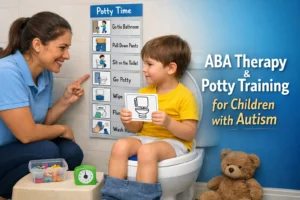
Here is a truth most ABA providers know but few say out loud: the most transformative hours in your child’s week are not the ones spent with the therapist. They are the ones spent with you.
Your child’s Board-Certified Behavior Analyst can design the most elegant behavior plan ever written. Your child’s Registered Behavior Technician can implement it with flawless precision for twenty hours a week. But if the strategies stop the moment the therapist walks out the door, progress will stall. Not because the therapy failed. Because the therapy never left the therapy room.
Research consistently demonstrates that caregiver involvement is one of the strongest predictors of meaningful, lasting outcomes in ABA therapy (CASP, 2024). Children whose parents actively participate in treatment generalize skills faster, maintain gains longer, and demonstrate improvements that carry across home, school, and community settings.
And yet, for many families, parent training feels like an afterthought. An optional add-on. Something the BCBA mentions during intake and never quite gets around to scheduling.
It shouldn’t be. At RenaSer ABA Therapy, caregiver training is not a sidebar to treatment. It is a structural pillar. And this guide will explain exactly what parent training is, why it matters so much, what it looks like in practice, and how you can start applying ABA strategies at home today, even before your first training session begins.
What Is ABA Parent Training?
ABA parent training is a structured, clinical service in which a BCBA teaches caregivers the specific strategies, techniques, and data collection methods used in their child’s individualized treatment plan. It is not a casual conversation in the hallway after a session. It is not a handout with generic tips. It is a formal, goal-directed intervention with its own treatment objectives, session plans, and measurable outcomes.
Here is the part many parents do not realize, caregiver training is a billable service under most insurance plans that cover ABA therapy. In the United States, all states have passed mandates requiring insurance coverage for ABA services for individuals with autism (NY Evidence Based Benefit Review, 2025). Medicaid programs across all states and the District of Columbia cover ABA when medically necessary, and caregiver training is recognized as a medically necessary component of comprehensive ABA programming.
This means your insurance is likely covering your right to receive hands-on training from a qualified professional. If your current provider is not offering it, you are leaving a critical service on the table.
What parent training typically includes:
- One-on-one coaching sessions with the supervising BCBA
- Demonstrations of specific techniques used in your child’s program
- Guided practice where you implement strategies while the BCBA observes and provides feedback
- Simplified data collection tools designed for home use
- Problem-solving sessions focused on generalization barriers
- Written summaries of strategies and protocols for reference
Why Parent Involvement Is Essential for ABA Success
A child receiving 20 hours of ABA therapy per week still spends the vast majority of their waking hours outside the therapy setting. That means the majority of learning opportunities happen at home, at the grocery store, at the dinner table, during bedtime, and at the playground. If the strategies used in those moments differ from the strategies used in therapy, the child receives contradictory information about what is expected, what works, and what gets reinforced.
This is not a theoretical concern. It is the single most common reason progress plateaus.
Generalization: Bringing Therapy Skills Into Everyday Life
In ABA, generalization refers to the ability to use a skill learned in one setting with one person and apply it across different settings, different people, and different situations. A child who can request “juice” using a picture card during a therapy session has not truly acquired that skill until they can also request “juice” from Mom at dinner, from Grandma during a visit, and from a teacher at snack time.
What generalization looks like in real life:
- Manding at dinner: Your child learns to request preferred items using functional communication during therapy. At home, you create opportunities for them to practice the same requesting behavior at mealtimes, using the same prompts and reinforcement the therapist uses.
- Transitions at bedtime: Your child’s therapist uses a visual timer and a first-then board to manage transitions during sessions. You replicate this approach at bedtime: “First brush teeth, then story.” Same language. Same visual. Same predictability.
- Social greetings in the community: Your child practices waving and saying “hi” during therapy. You prompt and reinforce the same behavior when a neighbor says hello on the sidewalk.
Without parent involvement, generalization becomes accidental rather than intentional. The child may never realize that the skill they use at the therapy table is supposed to work everywhere else, too.
Consistency Across Settings Accelerates Progress
Consistency is not about being perfect. It is about being predictable. When the same antecedent leads to the same expectation and the same consequence across environments, the child’s brain builds stronger, faster associations.
What consistency means in practice:
| Variable | In Therapy | At Home (Consistent) |
| Prompting | Therapist waits 5 seconds before prompting | Parent waits 5 seconds before prompting |
| Reinforcement | Verbal praise + token for independent response | Verbal praise + same token system for independent response |
| Response to problem behavior | Planned ignoring for whining; redirect to functional communication | Planned ignoring for whining; redirect to functional communication |
| Transition cue | “Two more minutes” + visual timer | “Two more minutes” + visual timer |
| Language level | Short, clear directives: “Shoes on” | Short, clear directives: “Shoes on” |
When this table looks the same across both columns, the child learns faster. When the columns contradict each other, the child learns that rules are situational, and problem behaviors that “work” in one setting will be attempted in another.
What Does ABA Parent Training Look Like in Practice?
If you have never participated in ABA parent training before, you may picture a lecture. It is nothing like that. Effective parent training follows a clinical model called Behavioral Skills Training (BST), which research identifies as the gold standard for teaching behavioral interventions to caregivers, educators, and paraprofessionals (DiGennaro Reed et al., 2018).
Observation and Modeling by the BCBA
Training begins with you watching. The BCBA runs a portion of your child’s session while you observe, either in the room or through a one-way window or video feed. This is not passive viewing. The BCBA narrates what they are doing and why, pointing out antecedents, prompts, and reinforcement delivery in real time.
What you are watching for:
- How the BCBA sets up the environment before making a demand
- The exact words, tone, and body language used when delivering an instruction
- The timing of the prompt: how long the BCBA waits before stepping in
- What happens immediately after your child responds correctly
- What happens immediately after your child responds incorrectly or does not respond
- How the BCBA handles problem behavior without escalating the situation
This observation phase is critical because it calibrates your expectations. You see exactly what the target behavior looks like, exactly what the prompt looks like, and exactly how reinforcement is delivered. You are not guessing. You are seeing the model.
Hands-On Practice with Feedback
After observation, you practice. This is the core of BST and the step that separates real training from information delivery.
The BST cycle:
- Instruction: The BCBA explains the target skill in plain language. “When Mateo reaches for the iPad, wait three seconds. If he says ‘iPad,’ give it to him immediately and say ‘Nice asking!’ If he does not, model the word and have him repeat it before giving access.”
- Modeling: The BCBA demonstrates the procedure with your child while you watch.
- Rehearsal: You take over. The BCBA steps back and lets you implement the strategy with your child during a natural interaction.
- Feedback: The BCBA provides immediate, specific feedback. Not “Good job.” Rather: “Your timing on the prompt was perfect. Next time, try to keep your voice neutral during the redirect so it doesn’t inadvertently reinforce the whining.”
This cycle repeats until you feel confident implementing the skill independently. The BCBA is not judging your parenting. They are coaching you in a clinical technique, the same way a physical therapist would teach you how to support your child’s exercises at home.
Data Collection Support for Parents
Data collection is the backbone of ABA. But the clinical data sheets your child’s therapist uses are not designed for a parent managing dinner, homework, and three other kids at the same time. Effective parent training includes simplified tools that capture the information the BCBA needs without adding more stress to your day.
Common parent-friendly data tools:
- Frequency tallies: A simple tick mark on a sticky note every time a target behavior occurs. Stuck on the fridge. Takes two seconds.
- Yes/No checklists: Did the child complete the morning routine independently today? Yes or no. One check per step.
- ABC logs: A three-column format (Antecedent – Behavior – Consequence) for tracking what happened before, during, and after a significant behavior. Filled out briefly after the fact.
- Timer-based tracking: Setting a phone alarm every 30 minutes and noting whether the child is engaged in the target behavior or not. Simple, low-effort, and surprisingly informative.
The BCBA reviews this data during supervision sessions and uses it to adjust the treatment plan. Your observations at home are not just nice-to-have. They are clinical data that directly shapes the intervention your child receives.
5 ABA Strategies Parents Can Use at Home Today
You do not need to wait for your first formal training session to start using ABA principles at home. The following five strategies are grounded in applied behavior analysis and can be implemented today with no special materials.
1. Using First-Then Language for Transitions
What it is: A simple verbal framework that pairs a non-preferred activity with a preferred one: “First shoes, then outside.” “First teeth, then story.”
Why it works: First-then language gives the child a clear, predictable structure. It answers the two questions their brain is always asking: “What do you want me to do?” and “What do I get for doing it?” By pairing compliance with access to a preferred activity, you create a natural reinforcement contingency without bribery. The reward is not a negotiation. It is built into the structure of the expectation.
Pro tip: A visual first-then board (two squares with Velcro picture icons) makes this even more powerful for visual learners. Place the non-preferred activity image in the “first” square and the preferred activity image in the “then” square.
2. Offering Choices to Reduce Power Struggles
What it is: Giving the child two acceptable options instead of a single demand. “Do you want the red shirt or the blue shirt?” instead of “Put your shirt on.”
Why it works: Choice-making gives the child a sense of autonomy within boundaries you control. Both options lead to the outcome you need (the child gets dressed), but the child participates in the decision. This reduces the power struggle because the child is no longer being told what to do. They are choosing what to do, from options you’ve pre-approved.
Key rule: Only offer choices you can follow through on. If you ask “Do you want to brush teeth now or in five minutes?” you must honor the five minutes. Broken promises erode trust and teach the child that your words are unreliable.
3. Reinforcing What You Want to See More Of
What it is: Catching your child doing something right and responding immediately with specific praise or a preferred outcome.
Why it works: The human brain repeats behaviors that produce favorable outcomes. If your child puts their plate in the sink and you say “Wow, you cleaned up without me asking! That’s amazing!”, they are more likely to do it again. If you say nothing, the behavior has no reason to repeat.
The key is specificity:
| Generic Praise (Less Effective) | Specific Praise (More Effective) |
| “Good job!” | “You put your shoes on all by yourself! I love that!” |
| “Nice work.” | “You used your words to ask for more juice. That was great communicating!” |
| “You’re being so good.” | “You waited so patiently while I was on the phone. Thank you for being patient.” |
Specific praise tells the child exactly which behavior earned the positive response, making it far more likely they will repeat that specific behavior.
4. Using Visual Schedules for Daily Routines
What it is: A sequence of pictures or icons displayed in the order your child needs to complete tasks, such as a morning routine (wake up → bathroom → get dressed → breakfast → shoes → backpack) or a bedtime routine.
Why it works: Visual schedules offload the executive function demand from the child’s brain to the environment. Instead of having to remember seven steps in order, the child simply follows the pictures. This reduces the need for repeated verbal prompting (which often escalates into nagging, which often escalates into conflict). The schedule becomes the boss, not you.
Implementation tip: Laminate the schedule and use Velcro so the child can physically move each picture to a “done” column as they complete it. This adds a tactile element and gives the child a visible sense of progress.
5. Planned Ignoring for Attention-Maintained Behaviors
What it is: Deliberately withholding attention (eye contact, verbal response, physical proximity) when a child engages in a behavior that is maintained by attention, such as whining, making silly noises, or mild tantruming.
Why it works: If a behavior is maintained by attention, any attention, even negative attention like scolding, reinforces it. Planned ignoring removes the reinforcement. Over time, the behavior decreases because it no longer produces the desired outcome.
Critical Safety Caveat
Planned ignoring is ONLY appropriate for behaviors that are maintained by attention AND are not dangerous. Never ignore self-injurious behavior, aggression toward others, property destruction that could cause harm, or elopement (running away). These behaviors require immediate intervention, not planned ignoring. If you are unsure whether a behavior is attention-maintained, consult your BCBA before attempting this strategy.
Expect an extinction burst: When you first start planned ignoring, the behavior will often get worse before it gets better. This is called an extinction burst and it is a sign the strategy is working. The child is escalating because the behavior used to work and they are testing whether more intensity will produce the old result. Stay the course. If you give in during the burst, you teach the child that escalation is the answer.
Common Challenges Parents Face During ABA Training
Parent training is not easy. It asks you to learn a new skill set while managing the emotional weight of raising a child with complex needs. Here are the most common struggles families face, and why they are entirely normal.
Feeling overwhelmed by terminology. ABA has its own vocabulary: manding, tacting, extinction, differential reinforcement, stimulus control. It can feel like learning a new language. A good BCBA translates these concepts into plain language and never expects you to memorize clinical jargon. If your training sessions feel like a lecture in behavioral science, ask your BCBA to simplify. They should.
Inconsistency between caregivers. Mom follows the protocol. Dad gives in during the tantrum. Grandma sneaks the reinforcer without requiring the target behavior. This is the most common barrier to generalization, and it is also the most human. Different caregivers have different thresholds, different communication styles, and different histories with the child. The solution is not blame. It is alignment. Every caregiver needs to attend training, understand the rationale behind the protocol, and practice the implementation. Written protocol summaries posted in the home help ensure everyone is on the same page.
Burnout and compassion fatigue. You are a parent, not a therapist. You are not expected to implement clinical protocols with perfect fidelity 24 hours a day. Research recognizes that parents of children with autism experience significantly elevated stress levels (PMC, 2024), and caregiver-implemented interventions must be realistic and sustainable. If a strategy feels impossible given your family’s circumstances, tell your BCBA. The best behavior plans are the ones that actually get implemented, which means they need to fit your real life, not an idealized version of it.
Guilt about past approaches. Maybe you have been yelling. Maybe you have been giving in during tantrums because you were exhausted. Maybe you did not know about reinforcement schedules or extinction bursts. That is not failure. That is parenting without training. Now you have training. Start from where you are. ABA is a forward-looking science. It measures progress from baseline, not from perfection.
Emotional difficulty with planned ignoring. Ignoring your child’s behavior while they escalate feels counterintuitive and emotionally painful. This is normal. Your instinct is to comfort, correct, or respond. Planned ignoring asks you to override that instinct in specific, targeted situations. It does not mean you do not care. It means you are choosing a long-term strategy over a short-term fix. And it gets easier as you see the results.
How RenaSer Supports Families Through Parent Training
At RenaSer ABA Therapy, we do not treat parent training as an optional line item. We treat it as one of the most important services we provide, because the research tells us what we see every day in practice: families who are trained, supported, and empowered produce the strongest, most durable outcomes for their children.
Here is what our parent training model looks like:
- Individualized caregiver goals: We do not hand you a generic parent training curriculum. Your BCBA identifies the specific skills your family needs based on your child’s treatment plan, your home environment, and the challenges you report.
- BST-based coaching: Every training session follows the Behavioral Skills Training model: instruction, modeling, rehearsal, and feedback. You practice with your child, not with a hypothetical scenario.
- Simplified data tools: We design home data collection systems that take minutes, not hours. Because if the system is too complicated, it will not get used.
- Multi-caregiver training: We invite every caregiver involved in your child’s life, parents, grandparents, babysitters, to participate. Consistency requires everyone speaking the same behavioral language.
- Bilingual support: Our team provides training in both English and Spanish, ensuring that language is never a barrier to understanding your child’s program.
- Ongoing problem-solving: Parent training at RenaSer is not a one-time event. It is an ongoing partnership. As your child’s needs evolve, your training evolves with them.
Ready to Start? At RenaSer ABA Therapy in West Palm Beach, FL, your family is never an afterthought. Our BCBAs partner with caregivers from day one, providing structured, compassionate, hands-on training that turns therapy goals into everyday wins. No waitlist. No jargon without explanation. No cookie-cutter protocols. Just a team that believes the most powerful thing we can do is equip you to be your child’s most effective advocate. Call us or schedule your free consultation.
You Are Not a Bystander in Your Child’s Therapy
There is a moment in every parent training journey when it clicks. You prompt the behavior the way the BCBA showed you. Your child responds. You deliver reinforcement at exactly the right moment. And something shifts. Not just in your child. In you.
You realize you are not just watching your child learn. You are teaching them. You are the one creating the conditions for their success, in the place where it matters most: your home.
ABA therapy works because of science. But science does not sit at your dinner table. Science does not tuck your child in at night. Science does not know that your daughter needs the blanket folded a certain way or that your son is more likely to cooperate after ten minutes on the trampoline. You know those things. And when your knowledge meets the science, progress accelerates in ways no therapist working alone can replicate.
RenaSer ABA Therapy exists to give you the tools, the training, and the confidence to be that bridge. Because the best ABA therapy is not something that happens to your child. It is something your entire family learns to do together.