If you have noticed your child flapping their hands, it is completely understandable to feel worried. Many parents first start searching about the autism spectrum after seeing this exact movement in a video or a family photo, or when they realize it happens more when their child is very excited or overwhelmed. Your mind can quickly turn to what this might mean for your child’s development and how you can best support them, and those thoughts can understandably feel overwhelming at first.
At RenaSer ABA Therapy in West Palm Beach, FL, our team talks with parents about hand flapping all the time. Our goal is to help you understand what you are seeing, why it might be happening, and what you can do next.
Hand flapping is one of the most recognized behaviors associated with autism, especially in young children. But while it’s often visible, it’s also frequently misunderstood. For families navigating an autism diagnosis, seeing their child flap their hands can raise questions about what it means, whether it’s harmful, and how to respond. The truth is, this behavior, while sometimes surprising to others, is a form of communication and regulation for many individuals on the spectrum.
Understanding the reasons behind hand flapping is essential to supporting your child with empathy and knowledge. This article breaks down what hand flapping really signifies in autism, how to differentiate it from other conditions, and when intervention might be helpful. Our goal is to guide you with clarity and compassion, empowering you to make informed choices and build stronger connections with your child.
What Is Hand Flapping?
Hand flapping is a repeated movement of the hands, fingers, or arms. It can look like quickly waving the hands up and down, flicking or twisting fingers, shaking the wrists, or moving arms near the face, sometimes together with jumping, spinning, or making sounds. Some children flap when they are very excited, others when they are anxious, focused, or overwhelmed.
In the autism community, this type of movement is often called “stimming,” which is short for self-stimulatory or self-regulatory behavior. Stimming means using repeated movements or sounds to get sensory input, to stay calm, or to express strong feelings. For people on the autism spectrum, these movements are usually not random or meaningless. Many describe them as a way their body helps them cope with the world and with big emotions.
It is also important to know that hand flapping can appear in children who are not diagnosed with ASD. Toddlers and young children sometimes flap when they are thrilled, surprised, or still figuring out how to coordinate their bodies. As they grow, learn language, and develop other ways of expressing themselves, the movement may become less frequent or disappear. So, the movement itself is not “autism” by definition. It is one possible clue, among many, that professionals look at when they evaluate a child’s development.
Why Do Children with Autism Flap Their Hands?
When a child with autism flaps their hands, the behavior usually has a purpose, even if it is not obvious at first. One of the most common reasons is sensory regulation. The world can feel extremely intense for many children on the autism spectrum- lights, sounds, textures, and social situations may come in “too much, too fast.” Hand flapping gives the brain a predictable, rhythmic sensation to focus on, which can help the child feel more grounded and less overwhelmed.
Hand flapping is also a way to express big emotions. You might see it when your child is incredibly happy or excited, such as when a favorite person arrives, when a song they love starts, or when they finish a puzzle. In other moments, it might show up when they are scared, frustrated, or uncertain. For many children who are still developing speech, their body “speaks” before their words can.
Hand flapping is considered a type of restricted and repetitive behavior, one of the core areas clinicians evaluate when diagnosing autism alongside social communication differences. Modern clinical perspectives, including the way we explain Level 3 autism, highlight that these movements are not “bad habits.” Instead, they often serve as meaningful coping strategies that offer comfort, predictability, or a sense of regulation. They can also indicate that a child may benefit from additional support or adjustments in their environment.
Is Hand Flapping Always a Sign of Autism?
No, hand flapping by itself is not always a sign of autism. Many young children without autism flap their hands when emotions are very strong, especially in the toddler years. In those cases, flapping may simply be part of normal development and emotional expression. As language, motor skills, and self-regulation mature, the movement often becomes less frequent.
Healthcare professionals become more concerned when hand flapping appears together with other early signs of autism. These might include limited eye contact, not responding to their name, delayed speech or very few gestures, a lack of interest in playing with other children, or strong reactions to changes in routine and sensory input. Diagnostic guidelines from organizations like the CDC and NIMH make it clear that autism involves a pattern of both social communication differences and repetitive behaviors that affect every day functioning, not just a single movement.
Hand flapping can also appear in other developmental or neurological conditions, or in children who are simply using movement to manage stress or excitement in their own way. For that reason, a diagnosis cannot be given through an online article. However, this information can support you in seeing the bigger picture and in deciding whether it is appropriate to consult a qualified professional for a thorough evaluation.
When Should Parents Be Concerned About Hand Flapping?
Seeing hand flapping once in a while is not automatically a reason to worry. Concern becomes more relevant when the behavior is frequent, intense, or accompanied by other developmental needs. For example, parents often decide to speak with a pediatrician when they see ongoing hand flapping together with delayed speech, very limited eye contact, regression in skills, or big struggles with everyday routines and transitions. Early warning materials from public health agencies point out that children who have significant language delays along with repetitive motor behaviors like hand flapping or toe walking are more likely to receive an autism diagnosis, especially when these signs appear early and do not fade.
You should also pay attention if the behavior creates safety risks or clearly blocks your child from participating in daily life. If the child is so absorbed in flapping that they do not notice traffic, stairs, or other dangers, or if the movement escalates into self-injury such as hitting themselves or banging their head, that is a strong reason to seek help quickly.
Another important signal is your own intuition. Parents often have a sense that “something is different” long before anyone else sees it. If your gut keeps telling you that your child’s development or behavior is not following the pattern you expected, it is completely appropriate to ask your pediatrician for a developmental screening or a referral to a specialist for an autism evaluation. Comprehensive evaluations usually include observations, questions about development and family history, and assessments of communication, thinking, and daily living skills.
Getting an evaluation does not change who your child is. It simply gives you clearer information and can open the door to supports such as ABA therapy, speech therapy, and occupational therapy when needed.
How ABA Therapy Can Help with Hand Flapping?
Applied Behavior Analysis, or ABA, is a science-based approach that looks at how behavior works in daily life. At RenaSer ABA Therapy in West Palm Beach, ABA focuses on teaching meaningful skills, supporting communication, and helping each child participate more comfortably in daily life and always in a respectful and collaborative way. It is about understanding what hand flapping is doing for your child and then teaching safer, more useful ways to meet that same need.
The starting point is usually a Functional Behavior Assessment, or FBA. During an FBA, a Board-Certified Behavior Analyst observes when and where hand flapping happens, what tends to happen right before, and how adults and the environment respond afterward. The goal is to identify the function of the behavior. Maybe your child is escaping noise, seeking sensory input, expressing excitement, or asking for a break without words. Once the function is clear, the team can design a Behavior Intervention Plan, or BIP, that focuses on support and helping the child self-regulate, instead of simply trying to reduce the behavior.
Often, the plan does not aim to eliminate all hand flapping. Instead, it focuses on safety, on reducing behaviors that truly interfere with learning and quality of life, and on building new skills. If flapping is mostly a calming tool, therapists may respect it in safe situations while also teaching your child to request a break, move to a quieter space, or use other regulating activities. If flapping happens mainly in moments of excitement, therapy might introduce alternative ways to express joy such as clapping, jumping on a mini-trampoline, or using words or pictures like “I am happy.”
ABA can also target communication and daily living skills so your child has more ways to express needs and handle everyday demands. As communication, emotional regulation, and independence grow, many children naturally rely less on intense stimming or use it more flexibly. At RenaSer, every child is supported with an individualized approach that reflects the values you can already see in our blog: protecting each child’s dignity, working closely with families, and viewing behaviors like hand flapping as meaningful messages to understand, rather than challenges to erase.
What Parents Can Do at Home?
Even before or alongside formal therapy, there is a lot you can do at home. A helpful first step is to simply observe without judgment. When you see hand flapping, take a mental note of what is happening around your child. Think about the time of day, the level of noise, how crowded or bright the space is, what your child was doing just before, and how they seem to feel. Over time you may notice patterns, such as flapping that appears mostly when your child is extremely excited, very tired, or overloaded by sensory input. That kind of information is very valuable for both you and any professionals who later support your family.
It also helps to respond with calm curiosity and understanding. Try to avoid scolding your child for flapping or telling them they are being “weird” or “bad.” If the behavior is safe and clearly helping them cope, it may be okay to let it happen while you gently shape other skills in the background. If it becomes unsafe or very disruptive, you can guide them toward an alternative that meets a similar need, such as squeezing a stress toy, hugging a pillow, doing big jumps, or taking slow breaths together, while you also work on communication tools like pictures, signs, or simple phrases. Professional guidance from an ABA team or occupational therapist can give you the tools to support your child.
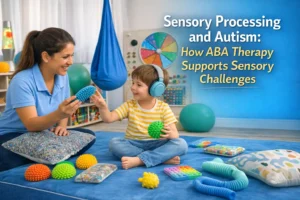
Supporting sensory needs can make a big difference. Some children do better with regular movement breaks, deep pressure input, quieter places, or predictable routines. Others benefit from headphones in noisy places or softer lighting at home. You do not have to redesign your entire life at once. Even small adjustments, based on what you observe, can reduce stress for both you and your child.
If questions about your child’s development continue to come up, you can note what you observe and share it with your pediatrician. You can ask clearly for a developmental screening or a referral for an autism evaluation. Most of all, remember that hand flapping is one part of who your child is, not the whole story. With the right information and support, you can feel more confident and informed.
If you live in or near West Palm Beach and would like guidance as you navigate your child’s next steps, RenaSer ABA Therapy can accompany you from the first questions to a personalized ABA plan built around your child and your family.